Tuesday, 19 July 2022


Monday, 18 July 2022
KCL Wargaming Presentation: Valid and Meaningful Assessment of Wargames (YouTube)

The first of the Wargaming Network's 2021-2022 public lecture series, 'Valid and Meaningful Assessment of Wargames,' featuring the research of Kate Kuehn, is now live on the Wargaming Network's YouTube channel.
Wargames offer a promising avenue for analyzing the quality of plans or decisions as well as for developing and assessing player or team capabilities. Within a military education context, wargames can reproduce authentic, complex environments that facilitate application and integration of critical 21st century learning skills like creativity, collaboration, and problem-solving. At the same time, these dynamic environments pose a challenge for traditional measurement approaches, evidenced by numerous critiques of simulation-based learning, games-based learning, and wargaming assessment practices. Purposeful integration of assessment into wargaming design is essential to demonstrating the value of wargaming for individuals and institutions. This lecture will highlight key principles of sound and meaningful assessment within wargaming contexts, synthesizing literature from measurement and gaming disciplines. The discussion will also integrate lessons from a case study that examined assessment challenges and practices of a U.S. military education program that is rapidly expanding these activities in its curriculum. The findings highlighted key mechanisms and opportunities to “bake assessment in” to wargame design and facilitation. The presentation seeks to offer a guide for practitioners who are seeking to implement valid and meaningful assessment of learning that can be adapted to their own wargaming practices.
Kate Kuehn is the Director of Institutional Research, Assessment, and Planning at Marine Corps University (MCU). In addition to managing the University’s institutional effectiveness process, she supports the evaluation of all MCU professional military education programs and directorates. Kate has spent 12 years working on evaluation and assessment of military education programs, providing advice on the design of learning assessments at the classroom, program, and institutional level. She is a member of the Military Education Assessment Advisory Group and has frequently served on military accreditation teams. Her research focuses on assessment and performance evaluation in complex contexts. More specifically, she is currently focused on assessment in team-based simulated learning environments. Kate has an MA from the Georgetown University School of Foreign Service and a BA from the College of William and Mary. She is a doctoral candidate at George Mason University’s College of Education and Human Development with specializations in education research methodology and educational psychology. Her dissertation proposes an assessment framework for collaborative, ill-structured games, and examines its application to educational wargaming practice.
Watch Kate Kuehn's presentation and the audience Q&A now at the Wargaming Network's YouTube channel, and we look forward to your participation in the upcoming 2022-2023 public lecture series.
Sunday, 17 July 2022
WD's COW 2022 at Shrivenham
To give you a better insight into the event I can do no better than direct you to some excellent bloggers (see below, fellow WD'ers who are also far quicker than me on the keyboard):

The whole event was scarily brilliant!
Blog Reports:
As you can see there was a fabulous array of games to be had plus you could get up close to some dark armoured denizens (see below, an evil looking T72, not recommended if you are either claustrophobic or like like a sense of "Health and Safety" in your working environment):

The whole event was scarily brilliant!
Saturday, 16 July 2022
Summer Read: SPQR by Mary Beard
My latest summer read (or rather listen to, at odd moments of the day such as dog walking and driving in the car) was Mary Beard's SPQR as background material for an unexpected wargame project with a friend who is taking up the hobby late in life. I spied Command and Colours in his games cupboard (I do know him as an active RPG fan) which led to a few leading questions and he revealed all. Then from board games he independently took the plunge into 6mm Baccus Late Republican Rome. I clearly have some catching up to do. Ancient Rome was an area I always wanted to dig deeper into, I have sated my Greek knowledge with books and extended DBA armies, but have only tinkered at Rome. I spied Mary Beard's SPQR book on his shelf and thought that a good supplement to by Osprey's Enemies of Rome compendium (see below, narrated by a voice actor but good nevertheless):

Boy these Romans are a funny lot, indeed what constituted being Roman seemed a flexible definition in itself. Background done, it is time to move onto some physical armies. I am aiming at some Spanish (Numantines) and Pontics to fight my friends Late Republican Romans. We have ducked the Punic Wars for the moment, but doubtless we will come back to them in teh future.
Monday, 20 June 2022
Black Seas and the USN
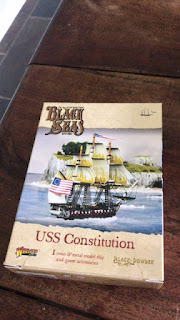
Here's my story. Many, many moons ago I purchased Black Seas and expected to dive into the "age of sail" in 1/700 scale and be a Horacio Hornblower reborn. Except, the wargaming butterfly that is I moved onto another project (anybody not see that coming?) way before paint met model and rigging sail lead to s a sense of frustration, so the box sadly languished in a dark place the loft. I did construct the free (well you had to but the magazine) giveaway frigate from the cover of a Wargames Illustrated magazine, but no further progress was made with a fleet. Then (several years later) a wandering eye in the local model store, sees a bargain but - end of stock - USS Constitution, the rest is predictable history (see below, "a love story starts" with an American super frigate):
Size can matter (see below, a case of we only budgeted for six but as the Carling beer advert says it all, probably the best in the world - normal frigate [RN/French/Spanish] in the background):
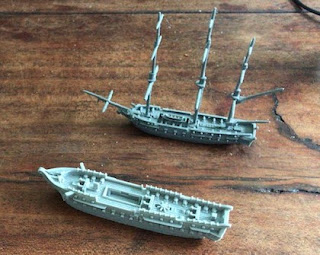
The master plan being that with the Master and Commander starter set and WI giveaway I have six brigs and four frigates, plus the USS Constitution ("old ironsides" herself - good timbers apparently). That means a basic USN fleet of two brigs and USS Constitution, a RN fleet of two brigs and a normal frigate and two brigs and a frigate for the French! Leaving two frigates in excess, whether to reinforce the French or British fleets, or make a Spaniard is the question (perhaps a wandering Russian frigate?). The only "possibly needed" expansion would be to include the bizarre fleets of the Barbary Pirates of the Mediterranean (where the teething battles of the USN were fought on the shores of Tripoli, as per the US Marines song) or the addition of a lazy fat merchantman or two. A small self-contained project, what could go possibly wrong, provided it gets off the painting tray.

Size can matter (see below, a case of we only budgeted for six but as the Carling beer advert says it all, probably the best in the world - normal frigate [RN/French/Spanish] in the background):

The master plan being that with the Master and Commander starter set and WI giveaway I have six brigs and four frigates, plus the USS Constitution ("old ironsides" herself - good timbers apparently). That means a basic USN fleet of two brigs and USS Constitution, a RN fleet of two brigs and a normal frigate and two brigs and a frigate for the French! Leaving two frigates in excess, whether to reinforce the French or British fleets, or make a Spaniard is the question (perhaps a wandering Russian frigate?). The only "possibly needed" expansion would be to include the bizarre fleets of the Barbary Pirates of the Mediterranean (where the teething battles of the USN were fought on the shores of Tripoli, as per the US Marines song) or the addition of a lazy fat merchantman or two. A small self-contained project, what could go possibly wrong, provided it gets off the painting tray.
Sunday, 19 June 2022
Evolution of British Army Infantry Sections 1914 - 2022 (You Tube Video)
Wow, I found this very instructive and informative with respect the WW2 (aka Chain of Command) and post WWII British Infantry formations (See link below):
Sunday, 5 June 2022
Painting US Vietnam Infantry - My Platoon 20 Collection (PART 1) Notes to Self
Background: Sometimes I acquire a "collection of figures" over time rather than for a project, knowing that at a point in the distant future when a critical mass/event is attained they will be painted (when the stars align and the "painting interest bug bites"). That ably described the relationship I have with my Platoon 20 Vietnam figures. I collected them [along with plastic vehicles models and plastic helicopter models] when I could - knowing "their" time has would come (see below, first in line for action - a US Infantry Officer):

Their time has come. The annoying thing about painting US Infantry in Vietnam is that it seems to be a futile exercise in painting various shades of green and then murkier green - everything seemed to fade and be stained differently. I am left with the feeling that "everything looks right and wrong at the same time", a bit like the war I guess.
The challenge for me is to make a distinct transition between the uniform and the webbing/flak jacket. It does seem to be a question of "Which of the fifty shades of green is it today? I am currently bouncing around with variations on the following painting recipe:
Uniform Tunic: Vallejo Model (924) Russian Uniform WWII [Base] with Vallejo Model (881) Yellow/Green [Highlight]
Webbing: Vallejo Model (887) Brown/Violet - although this seems to be a controversial choice in some quarters, as it may look too brown, with Vallejo Model (988) Khaki [Highlight]
Tunic and Webbing Wash: Vallejo Wash - Green mixed with Citadel Shade Nuln Oil, applied over all tunic/webbing area then repeat [Base] and then add [Highlight] -- Note: This step seems to make a real difference (++)
Flesh: Vallejo Model (927) Dark Flesh [Base] with Vallejo Model (955) Flesh [Highlight] - alternatively Vallejo Model (872) Chocolate Brown [Base] with Vallejo Model (983) Flat Earth [Highlight]
Gun: Vallejo Model (950) Black [Base] and Vallejo Model (995) German Grey [Highlight] - plus additional Vallejo Game Gun Metal [Edge Highlight]
Boots: Vallejo Model (950) Black [Base] with Vallejo Model (995) German Grey [Highlight] although others would say that is far too neat and should be "dusty brown" reflecting all the trudging through the mud
Helmet: Vallejo Model (924) Russian Uniform WWII [Base] with Vallejo Model Yellow/Green [Highlight] although I have yet to experiment with the four colour camo helmet look ... using Vallejo Model colours [(983) Flat Earth, 50:50 (882) Middlestone and (833) German Camo Bright Green, (924) Russian Uniform WWII, (890) Reflective Green]
Useful "Painting Guide" video links discovered to date, both of which produce works of art, disturbingly opting for Brown rather than Green Flak Jackets (variety is the spice of life):
- Rubicon - https://www.youtube.com/watch?v=LaeZFtxHL-c
- Wargames Soldiers and Strategy (WSS) - https://www.youtube.com/watch?v=4Hi6kc5gi9s
Painting Templates (think they are Flames of War):
Subscribe to:
Posts (Atom)