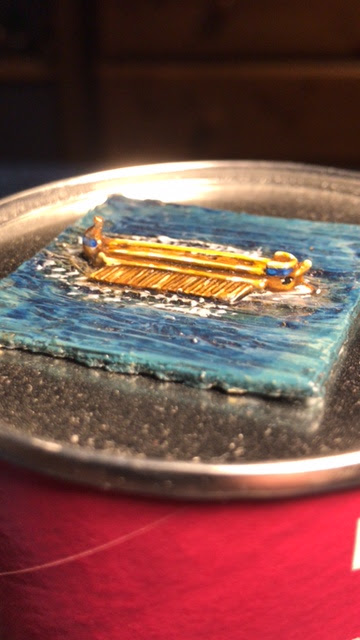
Showing posts with label 1/1200. Show all posts

Tuesday, 11 October 2022

First Experimental Battles - Triremes

Ok the kit (or certainly enough kit) has been painted and placed on the table = but how to play? (see below, "Red" Spartan triremes face-off against "Blue" Athenian .. as they represent ships, not squadrons, .. I think I will need more "space"): 


The "dice have it" .. coloured dice to represent hit points of damage .. six hits and you are dead. Double attacks from flank and rear. Working on the principle of one ship per model (aka "not squadrons") there  is a maelstrom of ramming and mad manoeuvre (see below, this Athenian started the day extremely confident but ended the day clinging to the wreck of his trireme with his gloating Spartan son sailing on - the Fates are extremely fickle):   


Seeking easier prey, I called on my friend, we'll call him "Dave" - who always loses in the most sportsmanlike way, so I laid a trap for him (see below, I gave him plenty of Spartan triremes to surround my defensive circle of Athenians in a prickly "kyklos" formation):  


All I had to do was survive for a set number of turns until the rest of the Athenian fleet turned up and scared the Peloponnesians away, simple. As the unwary Spartans approached I decided I would sprint out at them, like a released coiled spring (see below, unleash watery hell!): 


Except Dave had not read the script and biffed me up before the rest of the Athenians had time to turn up. Perhaps I should have waited more patiently for the attack to bounce off my prows and then I could have taken the unwary Peloponnesians in the flank or rear quarter as they drifted past in disarray (see below, as it was I traded blows and came off far worst, swimming home again): 


Sigh, I retain my 100% ancient naval record, the only way now being up. All hail to Dave the Navarch, I now tremble in your wake or rather swim pathetically!

Rules: Er, yes, there were some, sort of. I was going to play using a set called "One Hour Ancient Naval" (by "somebody" - Update [12-1-2022]: please see comments by Simon for clarification on this) whose name escapes me. However I had to roughly translate the movement in inches to hexes and related the up to 45 degree turns into a number of hex sides. I then slimmed everything down to do triremes only (Romans really liked boarding and shooting a lot), so the rules were a back of the fag packet and a bit in my head, so yes I kludged them together and called them in as I saw fit. The result being I pulled in rules from of things I had read historically or I think were in one of the many other ancient trireme rule sets I have previously read ... and so, the result was that I still lost, if I may say so in the finest of style and Dave managed his fourteenth game in a month ;) 

Monday, 3 October 2022

1/1200 Navwar Triremes - Greece in Peril [Again]

I tend to cycle round in my 'catholic' (as in disparate and varied rather than religious) wargaming interests and it is about time I revisited my 'old' (as in unfinished) ancient naval collection of triremes from the "Greece in Peril" period (see below, despite being 1/1200 you can get some nice detail on these Navwar miniatures - Themistocles to the front!): 


As one swallow does not make a summer, then one trireme clearly does not make a fleet (see below, the complete [or first stage] collection of Greek triremes, the two square bases were just products of experimentation to see what works, but they may also have a use representing a Navarch):  


This is "my starter for ten" Greek fleet with three squadrons on ten each, plus two command ships - or a left, middle and right of the fleet if I put the individual ships into sabots of bigger bases. Nothing deciding bar the need for flexibility of thought. As for the rules to use .. plenty of options, watch this space in due course ;)  

Footnote: It is sobering to reflect that I started this project in 2012! What a different world that was! For instructions on how I based and painted the above please see link below and keep scrolling down: 

Monday, 29 August 2022

Discoveries in a Bookshop - British Recognition Plates (late 19th Century to WWII) and a Trireme Book

There is always something to be found in a bookshop, the more rambling the better and I particularly like the buzz you can get when you comes across something you thought could not possible exist. Hence the sheer joy I felt when touching a physical book like this one (see below, spoiler alert I could not justify the purchase, but I still love the thought that this book collection exists):

https://www.pen-and-sword.co.uk/Richard-Perkins/a/2685

Seven volumes of illustrated warship plates exist (gulp which comprise Richard Perkins life's work). Something to compliment [perhaps dwarf would be be better phrased] my trio "Janes" [two volumes], "Conway" [three out of four volumes] and "Brown" [two volumes] warship collections - but ultra specific to the RN. In the (physical, sigh) book shop there were only three out of the seven volumes (but priced at £19.99 each which was so, so tempting). Back home, shopping around on Amazon and the like, I see you can get them cheaper than the Pen and Sword (even with there current discounted prices [approx £50]) but I think it might take some creative search energy to get the complete set. I was almost crying (inside, not in front of the children) leaving the store .. but hid it well. It was that "buy the set or nothing" moment.

There was a brighter note as I did purchase "something interesting" from the store, something pre "age of sail", back to those Greek trireme rowing days (see below, the selling factor being, albeit crude, the maps included inside - suitable for a stab at scenario creation or two): 


Something of an excuse or incentive for my 1/1200 Navwar trireme collection to come out to play sometime later this year or early next.  

Friday, 20 September 2019

Ancient Sea Battles using the "Lost Battles" System: A Future Project?

My Initial Thoughts: A post to set things rolling!


I sent this into the Lost Battles forum a while back ...


"I am getting interested in wargaming ancient naval engagements. Has anybody tinkered/adapted Lost Battles for the naval side of things? Was thinking of Salamis in the first instance (my painting tray is filling up with Navwar triremes at the moment). I am currently reviewing the rules available but they seem to be predominately ship-on-ship which seems ponderous for large battles and I am not sure "bath-tubbing" them down will achieve what I am after. The closest I have come to "Fleet Rules" is David Manly's "Greek Fire and Roman Fury". Your thoughts as ever appreciated."
Responses: (Detailed) Suggestions from Patrick
Units
Each unit would perforce be a squadron of ships, and around the time of Salamis this means triremes.  Hence units on both sides would be essentially similar, and we could take the Average Trireme as the basic unit.

Training and motivation of crews was usually higher than in some (particularly Achaemenid) land armies.  The three-layer Lost Battles morale system could still apply, but would Levy status ever be appropriate?  A look at the two Battles of Naupactus in the Peloponnesian War suggest that it might: Phormio's veterans achieved unexpected victories against one force twice their size and another four times their size.  The question is really whether the Athenian superiority is better represented by making their opponents Levy status or by assigning the Peloponnesians their historical abysmal level of command.

Provisionally, then, we might have Average Triremes (A*T) and Veteran Triremes (V*T).  Differences in the number and type of marines carried and/or the presence/absence of archers are probably not significant where the basic unit is a squadron of, say, 10 or 20 ships, but differences in tactical doctrine and procedure are, especially when reflected in construction.  Hence we could introduce Light and Heavy triremes, the former more effective at first contact and the latter in a continuing melee.

This would give us ALT, AHT, VLT and VHT; Average Light, Average Heavy, Veteran Light and (rarely) Veteran Heavy Triremes.  (We can worry about quinqueremes and the like later).

Unit Interactions
This would be the key to the whole system: how long does it take for a squadron of triremes to ram, board, sin and/or destroy the morale of another squadron of triremes?  Ten minutes?  An hour?  The Lost Battles combat system is designed to resolve cavalry fights quickly, infantry fights slowly (in the absence of a collapse of army morale), but is there any clue about which level of attrition applies to naval fights?

I would suggest that where one squadron catches another at a disadvantage (particularly in the flank), the fight can be over in minutes, whereas two squadrons locked together frontally might fight for hours.  Flanking is a lot more important in a naval fight than in a Lost Battles engagement because of the trireme's primary weapon: the ram.  Hence, in a frontal fight one might have a combat table similar to infantry vs infantry, but if attacking in flank the attacker would use a table similar to cavalry vs cavalry.

The next question is whether to include Spent status: is there such a thing as a spent squadron?  Or is a squadron either alive and effective or, for all practical purposes, eliminated?  We can probably justify Spent status for ships which have been engaged for some time and have tired crews, missing men and oars and perhaps a few hastily-plugged holes here and there.  This also allows us to fine-tune the treatment of rout, naval style.

Rout could be checked for by the Lost Battles rout/army morale/unit morale mechanism, with spent units having a -1 and veteran units a +1. A fresh unit which routs is Withdrawn for victory point (and campaign) purposes, while a spent unit which routs can be considered captured, which counts as Routed for victory point purposes on the basis that the cripples in the squadron will be taken.  Shattered (i.e. taking a hit while Spent) is Shattered, of course.

Fleet Command
Assuming we use a similar 5x4 grid, a similar command system might serve, with each collection of squadrons in the same tile/zone being considered a group and command points spent accordingly.  Generals (admirals) are probably best treated as Leaders, because their ability to move around on their own was limited (and if they did it would be very confusing to the squadrons they were with) so attaching them to a specific squadron seems merited.  The usual grades of Leader and their exemption allowances could still apply.

Movement
This can be tricky: I suggest this be related to unit scale, so that if each Average squadron consists of (say) five triremes, everyone has a move of 3, for ten triremes a move of 2 and twenty triremes a move of 1.  This takes account of the change in ground scale implicit in higher representation ratios.  Hence a fight like Naupactus can be quite mobile whereas a grand engagement like Salamis would proceed at a more stately pace.

Light Triremes would be allowed a free turn to flank as part of their move: this would to an extent represent their greater mobility.

Veteran trireme squadrons could employ two tactics against foes of lesser skill: from the front, diekplous (breakthrough); from the flank, periplous (envelopment).  Either requires a command bonus but confers +3 to that combat instead of +1.  A command bonus in other circumstances is still +1.

Morale
As touched on above, the basic Lost Battles morale rules could still work.  Veteran squadrons get +1, Spent squadrons -1 when checking morale.  Shattered squadrons count as Shattered; routed Fresh squadrons as Withdrawn and routed Spent squadrons as Captured (Routed).

This is an outline from first thoughts.  It may be something to build on or it may serve to demonstrate the impracticality of such a system.  There is one way to find out ...

Patrick
Responses: More information from Aaron
"There have been a couple of threads on this in the past and there is a file in the files section that might be relevant.

I don't really have much of a clue myself (not for the first time!) but here are a couple of thread conversations you could perhaps follow up on as well:"


Responses: Positive thoughts from Michael!

"I've spent some time working on this in the past (as I've worked on a simple wargames system for Android devices, inspired by Lost Battles/Strategos), but unfortunately nothing worth sharing in writing.
Basically speaking, though, my conclusion was that there is no reason why the Lost Battles system shouldn't also work excellent for ancient sea battles. Units have some interesting dynamics - small ships vs galleys, "boarding" galleys vs ramming allows for those differences in forces that make battles interesting. No hilly terrain, obviously, but coastline squares provide some flank terrain that will affect gameplay similar to terrain in LB."

Responses: From the original rules author Phillip Sabin ...

"That is a fascinating idea, but the topics are very different and it would need a lot of research and creative thinking which I have no time for at present.  Do by all means pursue it yourself if desired."

So .. What next?
Time to pull the Navwar 1/1200 scale triremes out of the loft perhaps.


Monday, 15 October 2018

Napoleonic Naval: 1/1200 Scale French v British (RN)

To me there is nothing quite as enchanting as 1/1200 scale Napoleonic warships in the thick of fight. Here a battle squadron of five British (three ships of the line and two frigates) coming to grips with two smaller Squadrons of French (two ships of the line and a frigate a piece). The game was in progress as I joined so some damage had already been accumulated two the leading French and British ships at the bottom of the picture (see below): 


The vans close to exchange deadly fire (see below):


The plan is for the British (who have the weather gauge) to finish off the bottom French squadron before dealing with the second French squadron. This means the rear of the British line is about to be exposed to some long range fire as their "T" is crossed (see below): 


The British Flagship locks horns with its French counterpart and a vicious boarding engagement follows. Not wanting to run foul of the British flagship the second in line abruptly turns to cut the French line (taking "hot" fire as she does so) while the lowly rear most British frigates escape serious damage from the French long range fire. The third British ship of the line decides to cross the French's rear "T" at a more deadly close range (see below): 


In the distance (see top of photograph below) the second French squadron slowly tacks, finding themselves out of position. There are two fierce close quarter actions afoot, with a dangerous looking "French-British-French" sandwich developing against the British flagship. Luckily for the British the opportunistic Frenchman intending to blast the rear of the British flagship sustained withering fire as it manoeuvred. The rearmost three British ships are tacking in an attempt to overwhelm the two stationary Frenchmen before teh second French squadron gets into the fight (see below):


The British flagship is suffering from a withering close range raking, which did not help the boarding action as the French are across her decks. All hangs in the balance. The fickle wind is not helping the six ships trying to manoeuvre into the battle (see below): 


There sadly I had to leave it as each round of the game was actually quite time consuming (old 1970 rules were being used). I later heard the British flagship had struck her colours but the two leading Frenchmen were in a very bad way so the game was called  a "Tactical" French win but "Strategic" Draw as the ships that had fought were no longer sea worthy and sank. 

Sunday, 19 November 2017

Experimenting with Naval Visuals (1/1200) for The Battle of the Denmark Strait (1941)

Like it says on the tin I was experimenting with a "small tactical sea base" to mount 1/1200 ships on to represent their configuration in a long range naval gunnery duel. First up is the KM Bismarck (see below, as yet no foaming wake or cutting white bow spray):


Is this a more dirty looking "Atlantic green sea" (see below, pulling back the shot to get a full profile):


The German "raiding party" together for Operation Rheinuburg on the circular tactical base (see below, a way of reducing the 20,000' General syndrome or is this just another case of wargaming madness?):


The Royal Naval guardians of the Denmark Strait, HMS Hood leading HMS Prince of Wales (see below):


Part of the "cloak and dagger" operation to shadow HMS Suffolk (see below, HMS Norfolk is still suffering from my reluctance to customise the my duplicate HMS Suffolk into a reconfigured HMS Norfolk. The more I look into it I keep seeing more bits I have to do):


A single ship does seem the more sensible basing (see below, you can see that I envisage putting on counters around the outside of the 360 degrees of the "tactical board". Peoples thoughts honestly appreciated!):


Finally something 'caught inbound' on the "Mighty Hood" (see below, the Bismarck fires eight but two "straddle-splash markers" unaccounted for, something is brewing inside HMS Hood. Also note 'X' and 'Y' turrets are about to 'clear arc'):


More thoughts and experimentation to follow and perhaps even a walk-through war game using the old favourite GQII.

Saturday, 28 October 2017

1941 The Denmark Strait Project: 1/1200 Prince Eugen "The Consort"

Not quite being able to face the modelling knife dilemma of HMS Norfolk just yet I decided to finish the KM Prince Eugen up to wargaming standard for the table (see below):


I quite like the overall effect and it is nice to finish off a model started a long time ago! Now back to HMS Norfolk!

1941 The Denmark Strait project: 1/1200 HMS Suffolk, "I am the Walrus"

On a "project roll" I painted up the Walrus so I can show stern of HMS Suffolk (see please note the hand painted FAA roundels):


Researching HMS Norfolk I see classic wargamer's dilemma, she is different to HMS Suffolk. I could just paint up the second County Class and let her simply be called HMS Norfolk, but really I should remove the "hanger area aft" and remodel the aft portion of the ship accordingly according to me lovingly collected naval books ... hmmm. Now that "I know" the difference I feel obliged that I "have to have a go"!

Thursday, 26 October 2017

1941 Battle of the Denmark Strait Project: 1/1200 HMS Suffolk gets her Colours (WIP)

Painting update: I managed to undercoat the bare plastic of a 1/1200 County class Airfix RN cruiser black (could not honestly tell you if it was the Suffolk or Norfolk yet) and the started the process of experimenting with paints for the RN colour scheme. The one on the  box cover of the 1/600 Airfix kit looks too pretty for the North At;antic to me. Initially I started with the paints that game with a Revell HMS Kelly/Kipling starter set but these were too shiny (IMHO) so I reverted to my Vallejo Game Colour range, Stonewall Grey and a White and Black for the most part. However I started mixing the two ranges together and liked the results (see below for the current WIP):


Hardly noticeable is the "bit of blue" at the stern of the ship (more photos later). I was 50:50 about the dark grey deck but it is has grown on me. From scanning the Internet I found some interesting links that truly inspired me:


Gawd bless the Internet ;)

Note to self: I still have to do the Walrus reconnaissance plane.

Wednesday, 25 October 2017

1941 Battle of the Denmark Strait Project: 1/1200 scale and Fletcher Pratt Rules

Courtesy of the old Airfix "Sink the Bismarck" kits (and the re-release some years back), Revell Mini-Ships (aka KGV) plus a strange eBay acquisition of some "destroyers" I have gathered the ships required for both the 'historical' and 'alternative historical' screening destroyers present battle (see below):


It is just a matter of finishing the started paint jobs. The Prince Eugen is almost completed, HMS Norfolk and HMS Suffolk next then those strange destroyers that look "close enough" to be A-H" class RN destroyers of the period. Note: They are are actually supposed to be Brazilian RN pattern destroyers sold by British shipyards on the export market. I cannot remember the manufacturer!

Saturday, 17 June 2017

My expanding Wargaming Library ... Fletcher Pratt Naval Rules

Courtesy of the History of Wargaming Project ran by the indomitable John Curry, but just as importantly coming highly recommended by both "Tim" and "Bob", I have (finally) purchased the infamous Fletcher Pratt Naval Wargame Rules of WWI and WWII (see below):


Purchase number two was the prerequisite "golf tees" to be used inverted as "splash markers" in teh game (see below):


The shape of things to come "a straddle" (see below):


Time to depart to the loft to dig out the 1:1200 Airfix "Sink the Bismarck" and Revell "Battleship series" waterline models!

Thursday, 26 January 2017

Naval Stuff on the Painting Tray

A range of naval projects on the go just now. Trying to keep it small scale, cheap and cheerful painting up a backlog of WW2 1/3000 Pacific American ships that have in the "loft space" for some time. The full production cycle is glimpsed below, finished products to the far left (aka USS South Dakota and USS Washington) with their painted sisters (aka USS North Carolina and USS Alabama) and across to some US cruisers undercoated. In the box behind some 1/1200 ancient triremes (see below, plenty more US and Japanese ships to come ):


Working out how best to do the "sea basing" effect on the cardboard, regretting painting some ships 'too well' before starting basing them  :(

DIY spreadable polyfiller being the magic key ingredient. I seem to be relearning all the "old lessons" of how to do it again!
 

Wednesday, 18 January 2017

The "White Fleet" of Corinth

Keeping forward momentum going on this project, a fresh order of Navwar triremes are being fitted out. Nomiated as the "White Fleet" what better Greek City State than Corinth to select (see below, filed, washed and cleaned up, UHU affixed to their bases and "gap filler" as a textured wave base):


I won't keep such a meticulous posting trail but I plan to try and do "a little bit per night". I was hoping to put down some Phoneticians but I had a slight issue with my order Navwar are currently sorting out.

Sunday, 15 January 2017

Trireme XI ... Varnish .. and finished (or am I?)

Protection, Protection, Protection! A shiny Humbrol "Gloss Cote" is applied (see below):


Protected but I would clearly say too shiny, time to dull it down with a (Humbrol) matte varnish (see below, aerial fleet versus fleet view [before they start closing]):


A close-up, Greek trireme coming out of the sun (see below, an individual ship view - comes up rather nice I think):


I am foreseeing one small problem, namely that of Greek Admiral's identification of "friend versus foe" without looking at the bottom of the bases (see below as the Red fleet extends around the more condensed Blue fleet, this would have been a historical issue too, as soon as the flanks are turned or the melee gets intermingled):


I shall leave you with image of a "sultry trireme" sailing on "the sea of wine" which was the cradle of civilisation the merry Mediterranean (see below):


Note: Yes, the next batch of triremes has been already ordered from Navwar ()including some Phoneticians and who knows by the time you are reading this, they may well be even in my sweaty, clammy hands! '

You know, I think I have caught the ancient trireme bug! How many do I need for Salamis?

Saturday, 14 January 2017

Trireme X ... WIP ... Oar and Bow/Stern white-tips

All ship, boats and even rafts make wave crests or white-tops, a touch of Vallejo Game Colour Off-White serves to so the trick (see below):


Close-up. Nothing wild and exciting, just some dabs of white along the oar banks and bow/stern (see below):


Overall I like the effect, however I need to think pragmatically with respect to "wargaming handling" these pieces will get shuffled around quite a lot, so I need to pay a bit of protection money to keep my hard one paint job together, aka a two coat varnish (gloss followed by a matte/satin).

Next: Varnish

Friday, 13 January 2017

Trireme IX ... WIP ... Sea and Wavetops

The sea base has already been primed in "shade" of Vallejo Game Colour Imperial Blue (72020). To this a wet-brushed "base" of Vallejo Game Colour Magic Blue (72021) for a bit of variation. However the blue colour though nice is IMHO coming through a tad (Yorkshire for a little) too strong (see below):


Next step .. dull down those waves with a Vallejo Green Wash and help retire the "blue" to teh background (see below):


Next step take two .. add a partial (as in I do not have to cover every mm of the base) Vallejo Blue Wash over the sea areas (see below):


The "final" sea touch is to add back the wave tops with a delicate barely wet-brush highlight of Vallejo Game Colour Electric Blue (72023) which serves to suggest something 'wavy' going on (see below):


Next: Add some white-water oar and bow splashes.

Thursday, 12 January 2017

Trireme VIII ... WIP ... The "Blue" Fleet of Athens

To combat Sparta's "Red" Fleet the Athenian naval prowess is shown in the "Blue" Fleet of Imperial Athens (see below):


Twenty triremes to do battle with.This should allow the small scale wargaming to start as soon as I "paint the sea bases",

Next: All at sea painting it many shades of blue and gren

Wednesday, 11 January 2017

Triremes VII ... WIP ... The "Red" Fleet of Sparta

The plan is to initially compose two fleets of ten triremes apiece to test out the various rule systems I have accumulated, starting out with simple scenarios and building up to small fleet actions. As per the tradition of wargaming I shall nominate them the "blue" and the "red" teams. It also seems natural to just forwards to the Peloponnesian War and nominate these test fleets as Sparta (Red) and Athens (Blue). To assist the tabletop gaming each of my squadrons will get a "colour" decoration (see below, the Spartan "Red" fleet/squadron):


Note: I have two types of Navwar trireme shown in the above photograph, the six to the top left of the photograph have no distinction "bow" and "stern" sections and have a continuous wall along the length, the remaining four are the more traditional trireme. The only difference appears to me being the opportunity to get more "red paint" (Vallejo Game Colour Scarlet Red, highlighted with Vallejo Game Colour Bloody Red) onto the models. To cover up any sloppiness I added a Vallejo Flesh Wash to the sides of the trireme.  

Next: The "Blue" Fleet of Athens

Tuesday, 10 January 2017

Triremes VI ... WIP ... "The Eyes Have It"

Am I crazy, paint "eyes" on a 1/1200 scale trireme, well they are distinctive but "blow me" they are small ... from six foot away (wargaming distance) would you even notice? The more I looked at pictures of old triremes the more I knew I had to do it (see below):


A close-up (see below, a white dab either side of the bow [trying to keep them level] the black dot the middle and underline top and bottom with a black line):


Sigh of relief, thirty six small eyes dotted .. job done. If I was trying to be fancy I could have given them different coloured pupils, but I am not that insane (for this batch at least).

Next: Fleet Colours

Monday, 9 January 2017

Triremes V ... WIP ... Last Wood Highlight

Last Highlights: Vallejo Game Colour Plague Brown mixed with Vallejo Game Colour Off-White, then with a final sparing touch of Off-White (see below):


Close-up detail of an individual ship (see below):


There is an old saying that "less is more" and that seems to run true for highlighting ;)

Next: Ship markings .. the "eyes" have it!