Showing posts with label Barbarossa. Show all posts

Wednesday, 26 February 2025

Skytrex 1/200 - KV2 Model

This (KV2) has been been on my Barbarossa 1941 (1/200 scale) wish list for a long time. It is the eternal frightening tank (along with its sister KV1) that the Germans encountered in 1941 and was looked upon with a sense of awe and arcane wonder. It was usually photographed with a German Landser looking at or standing on a knocked out or abandoned example (see below, stage one "flash removal"): 


It almost looks like a sensible tank in 1/200 - its insanity shows up more in 1/76. I remember I needed two of these for one of the Spearhead Scenarios. It was a "bunker buster" (a child of the 1940 Finnish War requirements for getting through the Mannerheim Line) rather than a true MBT, but it looked like a prehistoric monster. 

Note: That closes off my 1/200 - 1941 Russian Tank wish list, but for 1942-43 opens up my need for T60, T70 and lease lend vehicles (M3 Stuart, Valentine, Matilda, M3 Lee, Churchill, Tetrarch  - methinks I would need battalion batches of ten for each of these, apart from a singleton for the Tetrarch).  

Thursday, 25 July 2024

Spring and Summertime Audible Reading: WWII (Early War from 1939 to 1941)

Thanks to Audible (via listening in the car and while I am doing the washing up) I am able to keep up with my "electronic book time" (and in all honesty, I usually buy a paper copy of the books I like and have listened to too).  It is nourishing when you can mine a consistent meme or theme, even as a background task. I have recently gone back to one of my first loves of history, the early war period of WWII (clanky tanks, Stukas and all that stuff), with some nice new author "finds" and their revisionist reviews of oft forgotten episodes of the early war.

Reading List (Done):

Starting at the beginning - Case White: The Invasion of Poland 1939 (see below, Robert Forczyk is a great new author find for me and the Poland 1939 Campaign is covered in greater detail that I have managed to find before):


Of interest were the "learning mistakes" of the German Army, as not everything went right for them and how an alliance which looks good on paper is, when tested (France and Great Britain supporting the Poles - allegedly), falls apart through lack of any tangible help Britain and France could give Poland in 1939! The Allies in short wanted everything to go much slower, but were simply not given this luxury.  

The open fighting war in Poland now over, we move onto Narvik .. the campaign before the Low Countries started and the site of the Allies first "land" victory in WWII. This was after a bizarre naval start to to proceedings, where we almost saw an  "Allied invasion of Norway" first and arguably "an Allied act or war on Norway" (courtesy of the RN) ! A beguiling episode of unfathomable "what ifs" that could have spelled out a very different outcome. Overall an excellent book (see below, where bizarrely the displaced Polish troops helped the French and British inflict the first Blitzkrieg era defeat on Germany by the recapture of Narvik in what was the final moments of this ill-prepared campaign [on both sides]):


Then back to more familiar territory of France 1940 proper, but with a twist, not the familiar and beloved Alister Horne's recount, (France 1940: To Lose a battle) and looking predominately at Case Yellow, but instead just a review of that and then greater focus on Case Red. This is looking at the battle of France post Dunkirk, and what was termed the Second BEF's brief campaign. This includes the 2nd Armoured Divisions "trials and tribulations "in what was a travesty of combat, or "How not to attack with a British cruiser armed tank division in 1940, thinking it was the same as a French tank division and had supporting infantry". Fascinating early war "cringe" details, again a story of what could have been (see below, subtext - how allies can hurt each other as much as the enemy):


Then a real focus on Dunkirk from the German view, illuminating when considering the operation from a German perspective (see below, a huge take away was that the German effort to take Dunkirk was uncoordinated and from a C3 perspective was horrifically fragmented and certainly not combined arms, a fascinating read):


After the fall of France how long could Britain stand? Many thought, including Joseph Kennedy, JFK's father and American ambassador to Great Britain, thought not long. Britain was doomed as it could not stand alone. "We March Against England". This gives a peculiar twist to viewing and understanding  this period. Absolutely fascinating stuff (see below, again its from my latest author find, Mr Robert Forczyk):

This information was especially interesting when reviewing it against Paddy Griffith's epic1974 Operation Sea Lion game and the capabilities (see below, Paddy's book is full of of detailed notes and is available from the History of Wargaming Project):


Yet one more thing leading to another, the Western Desert comes into focus and another book from Robert Forczyk fills this gap nicely (see below, those early Italian and DAK battles covered in fascinating details [still as yet only available in hardback - so note to self, it is a book still for me to get]):  

Again a great book and brings a new perspective on the early war Western Desert campaign(s) and specifically Rommel's character and leadership in particular (a tank commander is being very hard on a felloe tan commander). Logistics, logistics and logistics! It is no good getting something after a hard fought battle if you cannot supply yourself sufficiently to keep it.

The above might explain my lack of posting over the last few months (first half of 2024), coupled with increased WhatsApp-Facebook-X  usage (a trio of digital distractions) and heck, a busy work-family life balance.

Reading List (To Do): 

Where next? Historically, all eyes turn East (as did Hitler) and the war swings in a very dramatic fashion as an 'irresistible force' hits an 'unmovable object' (Germany invades Russia) and believe it or not there is a book for that (see below, in truth there are many books, but this one concentrates on tanks which is a leading draw to me, thank you Mr Forczyk): 

Although I think, instead of a picture of a sexy Tiger Tank on the front cover (which is "just" in period, but will sell books for sure), I would have preferred a picture of a weather-worn, workhorse PzIII, which would have been much more appropriate IMHO. 

Note: Any more book recommendations appreciated and welcome, as I seem to have come to the bottom of my list (ready-use locker). 

Wednesday, 17 May 2023

Command Decision IV - Test of Battle (To Be or Not To Be the ONE? That is the question!). First looking back at CD1.

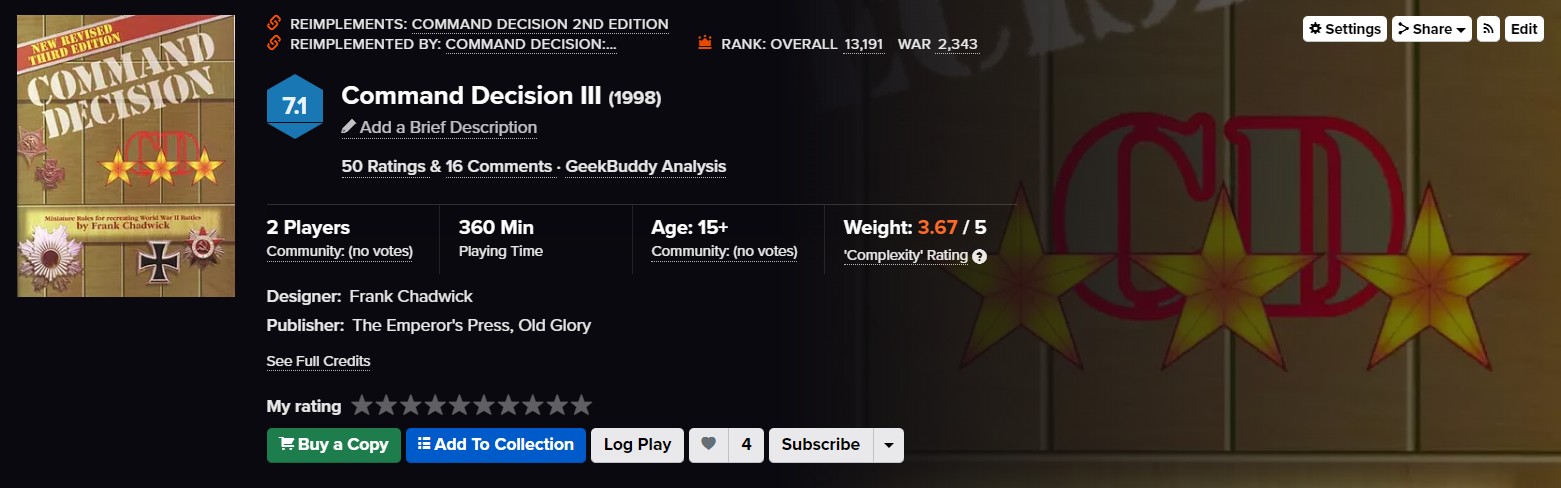
For some thirty years I have been searching the hobby game stores for THE WWII "land war rule set" that will be the saviour, or rather my excuse for, buying my 20mm (and 1/200) wargaming collections (now 15mm, 10mm and 6mm need also to be included). Like a little lost soul seeking love and attention I yearn for the "perfect enough" set of rules to make me happy. In this quest "Command Decision I, II, III and finally IV (Test of Battle)" have been acquired - as has been the likes of Spearhead and Crossfire. Alas the bonfire does not burn as well as I expected - although I always thought Command Decision was almost right and crossing the Rubicon (its morale and its orders for command decisions, hence the name). Nevertheless the 20mm collection grows steadily bigger with each passing year, but few games have really been played on the sacred table top (see below, what the collective from Board Game Geek thought of CD1):  


Piquing my interest in WW2 land war recently were these posts: 

Has Sgt Steiner succeeded where I have failed for all these years? In fairness teh games get rated better with each edition (see below, V2, V3 and V4 ratings - so Frank Chadwick must have been onto something I think): 


For my own consumption I revisited the large stack of Command Decision boxes I have, containing therein the sacred rules and decided to do a play-test, actually going back to CD 1 (fondly remembering the day I discovered it lurking on the shelves of the Aberdeen Virgin Store, in the Games Section alongside boxes of Computer Games, thinking "now this looks interesting", as I thought then and still think so now).  

So I took CD1 out for a stroll, to show two of my wargaming allies some 1941 Barbarossa action near Kiev. I chose a 3:1 odds battle of a Veteran German Motorised Battalion from a Panzer Division versus a Green Soviet Infantry Battalion defending a couple of hills in front of a town, a real slap in the face job, but "only" using the organic German and Russian battalion weaponry. A full strength German Panzer Grenadier Battalion is easy 3:1 in advantage over a weakened Soviet Infantry Battalion. I thought he morale extremes should make it a relatively quick battle, just to learn the rules again (I expected the Russian force to melt, as it did). Rather than player versus player, as it was a very static Russian defence (one command order) and an active German (our command orders) there was much more discussion about what the Germans could and could not do.

Most of the issues on the day really stemmed from the difference between reading the rules and getting the gist, then playing a game and finding the reference to the right rule quickly when simultaneously explaining it to two other wargamers (there were too many pauses but my friends were patient). The game (IMHO) played well though, the order system was very representative of the capabilities of WWII forces although it played slower than the accepted 1:1 timeline [game time v real battlefield time] in the Designers Notes (something which I always though should be quicker in CD .. later versions simplified mechanics and tried to streamline .. maybe just a case of familiarity). I think I still need to convince my compatriots though, one a die-hard convicted "Avalon Hill Panzer Blitz rules in miniatures is the way forward", the other likes to see a few examples before making his mind up. Which is all fair enough.

I smile though as I thought it worked and I will tell you why, because the German plan was worked through the CD1 Order System, not as an after thought. No such thing exists in Panzer Blitz and many other rule sets. Two dismounted (that is from trucks) German infantry companies went forward supported by their own "company organic but dropped off" MG Platoons and the well-sited MGs/Mtr of the Weapons Company which punished the Russian defenders. The armoured half-track company was kept in reserve. For simplicity I had the defender's positions already spotted (assuming the Panzer Recon and Veteran Infantry Patrol had doe their job well the night before). A quick full advance and a cautious cautious advance allowed the Germans to fire in the General Phase. This melted away the Russian defenders on the two hills, causing as expected an adverse morale effect for the third Russian company, in the town with battalion commander and a infantry weapon stand (they hunkered down - pinned). One German company however stalled with a bad morale roll (in fairness it took the brunt of the Russian fire). The German reserve was released by their battalion commander while the battered German company regrouped. With over whelming effective fire power the Germans reduced the defenders and their morale broke on turn four, the only survivor - the Russian indirect mortar platoon - decided discretion was the better part of valour and legged it. To me it had an authentic feel to it. Like anything after playing the rules once (especially after so many years) re-reading the rules again ironed out a few queries. Introducing spotting is the next key, as bumping into stuff you have not spotted and dropping indirect on stuff you have spotted is another tactical feature of the CD system I liked! 

PS1: Apologies for forgetting to take pictures of the battle!

PS2: Most significant features I had forgotten about was extreme range for infantry was double normal effective range - which makes life  little more dangerous. 


Sunday, 9 September 2018

Churchillian Page Turner .. Churchill's Hour

Just finished this WWII "fictional" narrative on Churchill's trials and machinations during 1941, Everything from domestic politics, tempestuous family relationships to tumultuous world events with the ever pressing strain of trying to induce the US into WWII (see below): 


A light enjoyable read but nevertheless thought provoking.