Showing posts with label Greeks in Peril. Show all posts

Monday, 3 October 2022

1/1200 Navwar Triremes - Greece in Peril [Again]

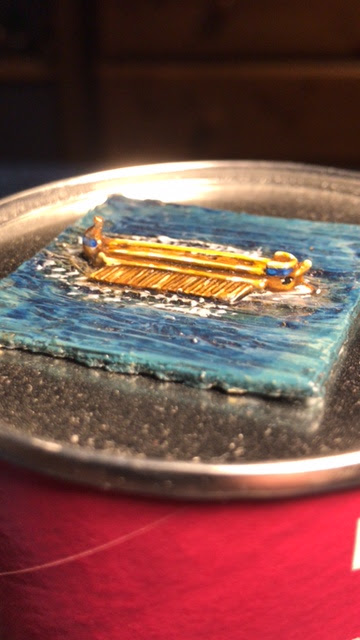
I tend to cycle round in my 'catholic' (as in disparate and varied rather than religious) wargaming interests and it is about time I revisited my 'old' (as in unfinished) ancient naval collection of triremes from the "Greece in Peril" period (see below, despite being 1/1200 you can get some nice detail on these Navwar miniatures - Themistocles to the front!): 


As one swallow does not make a summer, then one trireme clearly does not make a fleet (see below, the complete [or first stage] collection of Greek triremes, the two square bases were just products of experimentation to see what works, but they may also have a use representing a Navarch):  


This is "my starter for ten" Greek fleet with three squadrons on ten each, plus two command ships - or a left, middle and right of the fleet if I put the individual ships into sabots of bigger bases. Nothing deciding bar the need for flexibility of thought. As for the rules to use .. plenty of options, watch this space in due course ;)  

Footnote: It is sobering to reflect that I started this project in 2012! What a different world that was! For instructions on how I based and painted the above please see link below and keep scrolling down: 

Monday, 29 August 2022

Discoveries in a Bookshop - British Recognition Plates (late 19th Century to WWII) and a Trireme Book

There is always something to be found in a bookshop, the more rambling the better and I particularly like the buzz you can get when you comes across something you thought could not possible exist. Hence the sheer joy I felt when touching a physical book like this one (see below, spoiler alert I could not justify the purchase, but I still love the thought that this book collection exists):

https://www.pen-and-sword.co.uk/Richard-Perkins/a/2685

Seven volumes of illustrated warship plates exist (gulp which comprise Richard Perkins life's work). Something to compliment [perhaps dwarf would be be better phrased] my trio "Janes" [two volumes], "Conway" [three out of four volumes] and "Brown" [two volumes] warship collections - but ultra specific to the RN. In the (physical, sigh) book shop there were only three out of the seven volumes (but priced at £19.99 each which was so, so tempting). Back home, shopping around on Amazon and the like, I see you can get them cheaper than the Pen and Sword (even with there current discounted prices [approx £50]) but I think it might take some creative search energy to get the complete set. I was almost crying (inside, not in front of the children) leaving the store .. but hid it well. It was that "buy the set or nothing" moment.

There was a brighter note as I did purchase "something interesting" from the store, something pre "age of sail", back to those Greek trireme rowing days (see below, the selling factor being, albeit crude, the maps included inside - suitable for a stab at scenario creation or two): 


Something of an excuse or incentive for my 1/1200 Navwar trireme collection to come out to play sometime later this year or early next.  

Wednesday, 18 January 2017

The "White Fleet" of Corinth

Keeping forward momentum going on this project, a fresh order of Navwar triremes are being fitted out. Nomiated as the "White Fleet" what better Greek City State than Corinth to select (see below, filed, washed and cleaned up, UHU affixed to their bases and "gap filler" as a textured wave base):


I won't keep such a meticulous posting trail but I plan to try and do "a little bit per night". I was hoping to put down some Phoneticians but I had a slight issue with my order Navwar are currently sorting out.

Sunday, 15 January 2017

Trireme XI ... Varnish .. and finished (or am I?)

Protection, Protection, Protection! A shiny Humbrol "Gloss Cote" is applied (see below):


Protected but I would clearly say too shiny, time to dull it down with a (Humbrol) matte varnish (see below, aerial fleet versus fleet view [before they start closing]):


A close-up, Greek trireme coming out of the sun (see below, an individual ship view - comes up rather nice I think):


I am foreseeing one small problem, namely that of Greek Admiral's identification of "friend versus foe" without looking at the bottom of the bases (see below as the Red fleet extends around the more condensed Blue fleet, this would have been a historical issue too, as soon as the flanks are turned or the melee gets intermingled):


I shall leave you with image of a "sultry trireme" sailing on "the sea of wine" which was the cradle of civilisation the merry Mediterranean (see below):


Note: Yes, the next batch of triremes has been already ordered from Navwar ()including some Phoneticians and who knows by the time you are reading this, they may well be even in my sweaty, clammy hands! '

You know, I think I have caught the ancient trireme bug! How many do I need for Salamis?

Saturday, 14 January 2017

Trireme X ... WIP ... Oar and Bow/Stern white-tips

All ship, boats and even rafts make wave crests or white-tops, a touch of Vallejo Game Colour Off-White serves to so the trick (see below):


Close-up. Nothing wild and exciting, just some dabs of white along the oar banks and bow/stern (see below):


Overall I like the effect, however I need to think pragmatically with respect to "wargaming handling" these pieces will get shuffled around quite a lot, so I need to pay a bit of protection money to keep my hard one paint job together, aka a two coat varnish (gloss followed by a matte/satin).

Next: Varnish

Friday, 13 January 2017

Trireme IX ... WIP ... Sea and Wavetops

The sea base has already been primed in "shade" of Vallejo Game Colour Imperial Blue (72020). To this a wet-brushed "base" of Vallejo Game Colour Magic Blue (72021) for a bit of variation. However the blue colour though nice is IMHO coming through a tad (Yorkshire for a little) too strong (see below):


Next step .. dull down those waves with a Vallejo Green Wash and help retire the "blue" to teh background (see below):


Next step take two .. add a partial (as in I do not have to cover every mm of the base) Vallejo Blue Wash over the sea areas (see below):


The "final" sea touch is to add back the wave tops with a delicate barely wet-brush highlight of Vallejo Game Colour Electric Blue (72023) which serves to suggest something 'wavy' going on (see below):


Next: Add some white-water oar and bow splashes.

Thursday, 12 January 2017

Trireme VIII ... WIP ... The "Blue" Fleet of Athens

To combat Sparta's "Red" Fleet the Athenian naval prowess is shown in the "Blue" Fleet of Imperial Athens (see below):


Twenty triremes to do battle with.This should allow the small scale wargaming to start as soon as I "paint the sea bases",

Next: All at sea painting it many shades of blue and gren

Wednesday, 11 January 2017

Triremes VII ... WIP ... The "Red" Fleet of Sparta

The plan is to initially compose two fleets of ten triremes apiece to test out the various rule systems I have accumulated, starting out with simple scenarios and building up to small fleet actions. As per the tradition of wargaming I shall nominate them the "blue" and the "red" teams. It also seems natural to just forwards to the Peloponnesian War and nominate these test fleets as Sparta (Red) and Athens (Blue). To assist the tabletop gaming each of my squadrons will get a "colour" decoration (see below, the Spartan "Red" fleet/squadron):


Note: I have two types of Navwar trireme shown in the above photograph, the six to the top left of the photograph have no distinction "bow" and "stern" sections and have a continuous wall along the length, the remaining four are the more traditional trireme. The only difference appears to me being the opportunity to get more "red paint" (Vallejo Game Colour Scarlet Red, highlighted with Vallejo Game Colour Bloody Red) onto the models. To cover up any sloppiness I added a Vallejo Flesh Wash to the sides of the trireme.  

Next: The "Blue" Fleet of Athens

Tuesday, 10 January 2017

Triremes VI ... WIP ... "The Eyes Have It"

Am I crazy, paint "eyes" on a 1/1200 scale trireme, well they are distinctive but "blow me" they are small ... from six foot away (wargaming distance) would you even notice? The more I looked at pictures of old triremes the more I knew I had to do it (see below):


A close-up (see below, a white dab either side of the bow [trying to keep them level] the black dot the middle and underline top and bottom with a black line):


Sigh of relief, thirty six small eyes dotted .. job done. If I was trying to be fancy I could have given them different coloured pupils, but I am not that insane (for this batch at least).

Next: Fleet Colours

Monday, 9 January 2017

Triremes V ... WIP ... Last Wood Highlight

Last Highlights: Vallejo Game Colour Plague Brown mixed with Vallejo Game Colour Off-White, then with a final sparing touch of Off-White (see below):


Close-up detail of an individual ship (see below):


There is an old saying that "less is more" and that seems to run true for highlighting ;)

Next: Ship markings .. the "eyes" have it!

Sunday, 8 January 2017

Trireme's IV ... WIP ... "Brown Washed"

The Vallejo Game Colour Plague Brown paint was barely dry before the Vallejo Burnt Umber Wash hit these Greek wooden walls. It may seem a perverse "dampening down" step but the Brown Wash calms down the base brown for a sensible highlight stage (see below):


Next Stage: Final Wood Highlight

Saturday, 7 January 2017

Trireme III ... WIP ... Base "Highlighting" (Plague Brown) Complete

Now the fleet is looking a little bit more uniform (see below):


Next Step: Needs a "brown wash" to calm things (aka the wood) down.

Tuesday, 3 January 2017

Ancient Naval Rules circa Salamis .. "Bring out your triremes"

Drawn by a long, long term interest in replaying the Battle of Salamis and a fifteen year unfinished project of wargaming "The Greeks in Peril" DBA 15mm campaign (including the naval side of things) I gathered my things "old and new" to hand regarding ancient naval (see below, something old, something new, something borrowed something blue):


Listed out:

  • Naval Wargames Rules Fleet Actions by Richard Nelson (War Games Research Group 1973)
  • Poseidon's Warriors Classical Naval Warfare 480BC-31BC by John Lambshead (Osprey Wargames 2015)
  • Naval Wargaming From Ancient Galleys to Modern U-Boats by Paul Hague (Patrick Stephens Limited PSL 1992)
  • Trireme Tactical Game of Ancient Naval Warfare 494BC-370AD bt Ed Smith (Avalon Hill 1970)
  • Salamis 480BC The naval campaign that saved Greece by Willian Shepherd (Osprey 2010) for background reference [yes there is ton's of other stuff too]
  • And somewhere is a dusty draw there is a copy of David Manly's "Greek Fire and Roman Fury" to tinker about with
  • Addendum to when the above photograph was taken: Also of interest see: http://www.rodlangton.com/ancient/ancframe.htm, Ancient Naval Wargame Rules by Martin Johncock and Rob Langton (published by Langton Miniatures 1998)

Or rather for me, something very old and borrowed, something new, something old, something very old again and something relatively new'ish. Having said this it does not appear to be a "in vogue" period, more something people try once or twice, but perhaps I am currently wearing "Greek coloured glasses". The little models are "something old and bestowed from a friend" too, Navwar 1:1200 triremes (see below, they were lurking unpainted in a friend's "lead mountain"):


They do look cute if I do say so myself and then being happy I started to "border on madness" when I decided to 'dot the whites of their eyes' and give them a traditional "Greek Eye" (see below, you may have to 'click on the picture for a close-up look to even see it .. albeit rather blurred):


Cannot see it it? Neither can I, let's try another go (see below, er perfectly visible from six foot away .. why am I bothering, I guess because "It is there!"):


The "painting tray" is currently filled up with my "first fleet" (see below, note I have moved onto "circular disks" as they are (a) more practical .. they fit onto small hexagon battle sheets better and (b) less "sea-scaping" required .. something that always drives me bonkers .. aka I never think I am doing it right):


At least "these" (see above) should provide a means of testing out the rules mentioned above ('when finished' so don't lose that momentum). I know there are alternatives larger (1/300 and 1/3600), smaller [representing squadrons better] and some rather more expensive (see below, Outpost Wargames Services, http://www.outpostwargameservices.co.uk/ from their 1/3600 range, which I like but I seemed to be doing more "sea" than boat and these may suit David Manley's rules better):


Watch this space in 2017 lovers of Greek rowers and trireme rams ;)

Extra bit: Inspiration found on the web http://wabcorner.blogspot.co.uk/search/label/Galleys%2FLongships%2FWatercraft

Thursday, 27 June 2013

A "hand delivered" Parcel of Ancients

I didn't "go to the show" (Sheffield Triples) but I did manage to get some toys courtesy of a 'personal courier' who was attending the event for the Impetus games, so ...


In preparation for the forth coming staging of Peloponnesian War battle [418 BC] 'The First Battle of Mantinea' (scheduled for this autumn [2013]- where the Athenians have a last chance to pick up a long sought after victory, 2-0 against them in the 'Greek' campaign) I have acquired some more Irregular Miniatures 15mm hoplites - 32 figures all told. As well as being needed to flesh out the hoplite count for Mantinea it also nicely finishes of a DBA/DBM/FoD/Impetus 'Greek hoplite army' contingent (well the metal is amassed it is only a matter of painting and basing them now, see below):


Plenty of filing of "flash2 to be done here! In addition to these lead warriors my long running Circus Maximus project (to add miniature figures to the classic Avalon game) got a surge of six extra chariot combinations [running/wrecked]. Here stand another six 'running' chariots next to the original fifteen year old painted Ben Hurr lookalike (see below): 


Naturally those six magnificent chariots and charioteers plus their steeds (the most important, nay intelligent, part of the team IMHO) could be reduced to mere Colosseum 'churn' (see below, again alongside a fifteen year old seventh "wreck" counter)


These "ancients" are rather a stark contrast to my current WWII 20mm projects, but it always good to have a "Plan B" to keep things ticking over.

Note: Seeing that this is !post number 617" to this blog I have to make some passing reference to 617 Squadron "The Dambusters" especially since it is the '70th Anniversary' of the raid. Lest we forget!

Thursday, 6 December 2012

Platea 479BC Refight (Take II) Part V

Sparta fights on to the last hoplite, her army now launches itself off the ridge line in a fury at the Persians who were also trying to outflank the Spartan right (see below):


The Spartans survive the torment of the "torrent of Persian arrows" as they close to come to grips with the Persian infantryin hand to hand combat. Here the contest is one-sided to Sparta, as we see a Persian SparaBara Archer unit disintegrate under the momentum of the Spartan hoplite phalanx (see below). The Spartan helots (Hoard) even holds its own against the regular Persian infantry.

This Spartan success rather evens things up,all square:
Persian Casualties (1) versus Spartan Casualties (1) 


However grim things have come to pass in the center of the battlefield for Sparta. Two more Spartan Spears have fallen (see below). The Persian Cavalry and Light Horse with their faster movement simply 'closed the door' on another slower moving Spartan Spear. The (one) elite Persian Spear (+4) unit fixed a Spartan hoplite Spear stand to the front as a unit of bow attacked it in the rear. Both units were in dire straights and must 'win' the combat or die. The Sparta dice rolling this time failed to deliver a miracle.
 
The hand of fate moves to favour the Persians:
Persian Casualties (1) versus Spartan Casualties (3)  

The Spartans are now but one casualty from being demoralised!


As expected, Sparta fights back and destroys another Persian SparaBara (see below, top left), but in the center of the battlefield the Persians have surrounded the last Spartan valiant hoplite Spear stand. Its position looks totally hopeless (but never tell that to a Spartan to whom the concept of "thantos" is laughable). 

Sparta has almost evens the contest:
Persian Casualties (2) versus Spartan Casualties (3)  


But tragedy strikes the Spartans from an unexpected quarter, their Helots on the right flank (see below) are struck down by a cruel volley of Persian arrows which"darkens the skies" (the Helots were starting at +2 but are reduced to +0 by the sheer weight of arrows [two overlaps] while the Persian Bows are still firing at +2. The Helots are doubled and die horribly). Alas the surrounded unit of Spartan Spears dies too,in true heroic fashion it must be said.

The Spartan command breaks and goes demoralised (something almost unheard of in Ancient times) and the fighting value of the remaining Spartan Spears immediately drops to from +4 to +2. All Pausinius can do his hold a PiP dice worth of units in place (no maneuvering, which seems unduly harsh, but BBDBA seems to want to bring a very quick end to demoralised commands, unlike the later sister rule-set DBM which allows more latitude in demoralised commands fighting on [or have I simply got this BBDBA rule wrong? Answers on a postcard please!]).
 
Persian Casualties (2) versus Spartan Casualties (5) demoralised 
Allied Greek Casualty count (6), six more required to end the game


Attention now shifts to the other side of the battlefield where the Thebans are now once more formed back into a more or less straight battleline. The Thebans heartened by the Persian successes against the Spartans fearlessly assault the Athenians fixed on the ridge line (see below). One significant advantage to the Thebans is that the Athenian strategos was so worried by the "theoretical" possibility of the victorious Theban Psiloi 'stand' (see previous post) attacking the Allied Greek Camp he detached "two" Athenian stands of Spear to chase it off. This could be deemed as reinforcing failure and taking away vital troops from the locus of the battle, especially since Spears only move two inches and the Psiloi three inches per turn. In addition one stand of Spears would have sufficed. Now as a result of this nine Athenian stands face eleven Theban stands, only the defensive ridge bonus of (+1) to the Athenians makes it still an even fight.  


In the ensuing combat the Athenians are drawn from the hill (losing even this defensive bonus), in search of a desperate "local tactical overlap" advantage.However they lose an Athenian Spear unit in the process. The Thebans simply out-flank the Athenian right and get ready to "close the door" on them (see below):

Athenian Casualties (2) versus Theban Casualties (0) 
Allied Greek Casualty count (7), five more required to end the game, only two more needed for Athenian demoralisation to strike


With their right flanks turned the Athenians are doomed, in the next turn of two more Athenian Spear units are destroyed, ridden under the sandals of the Theban hoplite phalanx (see below):

Athenian Casualties (4) versus Theban Casualties (0) 
Allied Greek Casualty count (9), technically three more required to officially end the game but as stated this is a mere technicality as the Athenians (as per the Spartans) are now demoralised. All effective "Free Greek" resistance is over. The game is called to the Persians as a massive strategic win.

And so ... Greece falls under Persian rule soon to be followed by the rest of Europe as the Persian Empire becomes the only Empire in the Ancient World and may even dominate the globe. Hmm,pause for thought there! My guess is that Thebes will find that being on the winning side with the Persians a very bitter-sweet experience because it makes you effectively Persian, but at least with a big house and vineyard.


A turn up for the books and certainly not the Hollywood or book ending we all know. Many thanks to the enthusiastic participants who made this such an enjoyable night to umpire and I can now proudly award them all their wargaming spurs "won in combat".
Wednesday, 5 December 2012

Platea 479BC Refight (Take II) Part IV

A Spartan death in slow motion

There is a chaotic melee in the middle is (see below):


The Spartans push forward resolutely (see below):


But despite their forward progress, the Spartan right is being dangerously enveloped from the Persian hoard (see below):


Worse still, the Persian Light Horse reappear in the Spartan rear (see below) and a "do or die" die roll is required (Persians +3 overlapped down to +2, Spartans +4 overlapped [rear] down to +3 but if they lose they die).


The mighty "hand of Zeus" tells all (see below):


Allied Greek Casulties: 
  • Athens (1 stand lost, lose three more stands to be demorialised)
  • Sparta (1 stand lost, lose three more stands to be demoralised)
  • Allied Greek Army (2 stands lost, ten more to reach army break point)
Persians and Medizing Greeks:
  • No casualties


It is the potential for many more Spartan casualties that is most worrying from the Allied Greek perspective! However there is "good news" for the Free Greeks the Spartan Army has at last come off the ridge line and is advancing towards the Persians. Will they get there in time?

Next .. End Game

Tuesday, 4 December 2012

Platea 479BC Refight (Take II) Part III

The first blood is let ...

"Pop" there goes a Greek Psiloi. First blood going to the Thebans. The Athenian strategos rolled his eyes imploringly to the heavens after his inauspicious start to "wargaming combat" with of roll "1". The Thebans tucked in a nice competent "5" to butcher their opponents mercilessly. "Route 66" to the Greek Allied Camp was now open (see below):

Casualty count:
  • Athens down 1 stand, three more and their army goes demoralised
  • Allied Greek Army 1, eleven more required to army break and rout point


If you thought the Thebans looked in a 'vulnerable' from the last post, take a look at this! Is this really the mighty Theban army of legend or is it a bunch of dancing farm girls "stripping the willow" in front of the massed hoplite spears of the Athenians!!!! (see below). So are the Athenians going to "go for it" and roiute those disorganised ? Nope, they stick resolutely on the hill (obviously listening to their granddads 'fireside' way of doing things in the old days). 


Meanwhile the Spartans "have" toed forward to enjoy the pleasure of some ineffective Persian archers (see below), but why push forward with only four stands of spears, leaving the other eight stands of the Spartan army outside of effective supporting distance (which is about two inch when you are a hoplite). I've got a bad feeling about that Sarge! OK. Yes, yes it is far, far easier to watch and umpire than to play (your first game) as shown by the tension marks on the forehead of Pausinias throughout the battle.  


Clash of arms, CRUNCH! 

The Spartan four take on the Persian six, now that is the mark of a brave and confident Spartan commander (see below). The Combat dice odds do still favour the Spartans though (all Spartan Spears are at +4) to the horror of the Persians (+2 Light Horse, +3 Cavalry, +2 Psilio, but at least a +4 Spear [plus a friendly overlap] at the end, reading right to left down the line). If the Spartan starts well he might well get a overlap advantage too.

Note: in strict DBA terms: recoil and the "buttocks of death" were not being strictly enforced for simplicity's sake .. as seen here it would have potentially made it disastrous for the Spartans as if they suffered multiple recoils they could eliminate each other which seems overly harsh. However after "reviewing the photographs", I see "Greek groups" contacting "Persian individual" elements which would in theory force the individual element to align to the "Greek group". So in a way I think it all panned out 'even' to make as straight battle pairings.   


Good combat dice means that the Spartan wins all the combats but finds out that the light and mounted recoil and flee from the slow moving spears without him achieving any kills (see below). Now the Spartans have to await the Persian response as Mardonius rolls his Pip dice.


The Persians manfully come back at the Spartan and through a "skillful feat of arms" (aka good dice throwing) push the Spartans about into a ragged line (see below). Still no "deaths" caused but the Spartans will have to spend a lot of PiPs to sort out this messy affair of a battle line into some semblance of order. Still if he backs up these four brave Spartan stands with the other eight stands of his army there may be time to win this convincingly. However at this moment in time they are fixed firmly to the ridge line facing off the other Persians and "not fighting". Is that wise Pausinius?


The Spartans are up next but ... where has that Persian horse gone to (with its five inch movement, yes that's two and a half times faster than a hopite [in "Hancock's half hour" old money])?