Since the publication of the book there has been archaeological work that seems to suggest (prove?) that German weapons had been fired within the perimeter of a RAF radar station at St Laurence! So, so interesting! There has even been a series of follow up talks in 2025 regarding its finding, so I will be watching to see if there is some form of follow up publication .. or even scenario scenario "in the wind"!
The ongoing adventures of a boy who never grew out of making and playing with plastic model kits (and even some metal ones too). Also a wargamer in search of the perfect set of wargaming rules for WWII Land and 20th Century Naval campaigns.
Wednesday, 20 May 2026
Post Partisan Research - Early War Miniatures: The Raid (WW2 Isle of Wight Kommando Attack)
Since the publication of the book there has been archaeological work that seems to suggest (prove?) that German weapons had been fired within the perimeter of a RAF radar station at St Laurence! So, so interesting! There has even been a series of follow up talks in 2025 regarding its finding, so I will be watching to see if there is some form of follow up publication .. or even scenario scenario "in the wind"!
Tuesday, 5 May 2026
Audio Book: Prevail (The Inspiring Story of of Ethiopia's Victory Over Mussolini's Invasion 1935-1941)
Friday, 14 November 2025
Book: Victory to Defeat (Richard Dannatt and Robert Lyman)
We had won, with a magical formula of 1918 combined arms warfare, hard earned through bitter experience of four years of fighting and then we lost or rather forgot it! Such criminal complacency meant that another generation of youth experienced a second World War. The people who "had practical experience of fighting it" drifted away and did other things. The world wanted to be pacifist. The politicians became politicians again and took their eye off the ball, they took the easy option, cutting to the bone military spending. The "war to end all wars" was supposed to be exactly that, although there was a dissenting feeling in Germany that in 1918 they had not been defeated in the field (the very same myth used by National Socialism and the "stabbing in the back" from a caste of politicians). However, in 1918 the Allied armies pummelled the German Imperial Army to its knees in the 100 Day Offensive with "combined arms" and overwhelming industrial power (infused with the additional of the American Expeditionary Force (AEF) - which was not specifically called out in the book). The armistice came, it signalled the end of the war (11/11/1918), then came the Treaty of Versailles with its own cauldron of snakes that poisoned international politics for decades to come. The League of Nations was born and withered on the vine through application of realpolitik between the Great Powers. In Britain there was a spirit of the war is all over now, let's get back to normal (proper) peacetime soldering as we have an empire to run. Contemplation of another war of this magnitude was an anathea. Politicians who thought different were not elected .No peer war was expected within the next ten years, so colonial policing was the order of the day for the British Army. The British Army was shrunk to a rump (prioritising Empire over continental commitments) and certain important or maverick personalities played with their own hobby horses and pet projects within the confines of the Treasury's frugal remit. Britain literally became an island nation behind a sea and air barrier, the Royal Navy in her senior service role and the over promising of the RAF (capable of punishing enemies with the bomber and protecting the homeland with the fighter) gained favour. There was no appetite for a tangible army capacity capable of force projection on the continental mainland to deter the rising power of Nazi Germany. Without such an army, even if scaled back, there was no way of keeping the hard-earned organisational knowledge of "how to do things" at scale. Then the chickens come home to roost through a series of international crisis and the early war defeats of 1939-40 (see below, a tale of the once and future king - the practice of combined arms warfare, found - lost - then painfully recovered from 1942 onwards; although the British 1940 successes of The Western Desert Force against the Italians - Wavell's 10,000 (Beda Fomm), the East African Campaign and reconquest of Ethiopia and Somaliland, again against the Italians, was not called out):
The allegory or case study to modern times (2022+) is called out, how different is the current political situation with Russia and continental Europe? The message is clear. Let us not make the same mistake again. The world of 2025 seems horribly similar to the 1930's and the lead up to the Second World War. This time we also live in a nuclear age where the stakes could not be higher. The general (Dannatt) also seems to indirectly pushing the value of wargaming in military circle - when you do not have the physical items it does not stop you from imaginative thought experiments (with reference back to the Germans formulating the doctrine of mobile warfare in the 1930's without any tanks - they wargamed and conducted imaginative field exercises). If you want peace, then be sure you are prepared for war. A protagonist thinks twice before attacking a prepared potential victim - or rather the "victim" is not viewed as a victim but rather a "respected or feared foe". Deterrence has to be credibly backed up or the paper tiger will be called out. Knowing what form of armed forces (Army, Navy, Air, Cyber, Space, Civil) you need is the key to knowing what capabilities you have to nurture or retain for future use (and their scalability for wartime needs). That comes from an unending intellectual engagement across the whole spectrum of government. I for one cannot fault the main theme of the message!
David Isby gave an informative and interesting review of the book too:
Thursday, 15 September 2022
Inter War USN Planning - WWII War Plan Orange Evolution
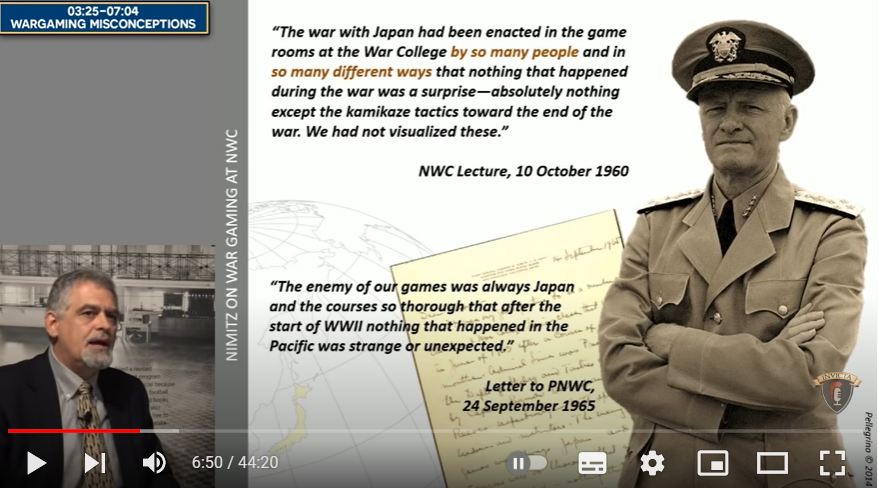
I can highly recommend this talk from Peter Pellegrino (of NWC fame) with respect to teh evolution of the US naval strategy against the IJN aka, War Plan Orange (see below, Peter never disappoints):
https://www.youtube.com/watch?v=KXal8JUqAfQ
00:30 - Introduction 03:25 - Wargaming Misconceptions 07:04 - War Plan Orange Explained 12:05 - Schools of Thought 13:55 - WW2 Naval Strategy 30:36 - Recap of Myths 32:08 - Interwar Wargaming 34:23 - 1932 USNWC Curriculum 36:08 - USNWC InfluenceEspecially valid in putting into the correct perspective the "Nimitz Quote" (see below, not using wargaming as the oracle's tool - but rather as a tool that could sharpen a commander's mind):
War Plan Orange (Japan):
- Phase 1: Protect Western Coast of USA!
- Phase 2: How do you get to Japan ["The Hard Bit"]?
- Phase 3: Defeat and Invasion of Japan?
Fantastic though, the NWC finally goes Rainbow (see below, why have one plan when you can have four+, one of them has got to work, right?):
But at the heart of it all was the concept and practice of adversarial "gaming" .. 318 games [scenarios] .. and by god they did it every day when they were at the NWC .. learning how to play (a month of the school year) ,, both at a tactical, operational and strategic levels (see below, including multi-aggressor [even RN "Red"], multi-discipline [Sailors, Marines and Aviators] multi-spectrum [even testing out hypothetical ships] - respect and well done, that shaped the senior officer cadre for WWII):
"And" they always finished with "The Battle of Jutland" (RN v HSF), turned on its head and into "The Battle of Sable Island" (RN v USN). Something I can perhaps aspire to use as a background campaign or scenario development for my 1/3000 Navwar fleets ;)
Monday, 28 December 2020
Fun with Card: WWI and Inter-War Period (Free Downloads)
Just sharing from a friend who spotted this:
http://www.landships.info/
Some beautiful work on display!
Excellent resource and fun to play with, although the whole concept of "card models" may sound daunting - you never know until you give it a go ;)
Saturday, 9 March 2019
Mystery Early Twentieth Century RN Ship Identities, Help Sought
Picture 1:
A "gun boat" or "armoured cruiser"?
Bob Cordery's spotted these as: "looks very like the side view of one of the Brazilian river gunboats built by Vickers and taken into RN service after the outbreak of WWI. Two of them were used to destroy the SMS Koenigsberg when it was trapped up the Rifuji River. https://en.m.wikipedia.org/wiki/Humber-class_monitor"
Picture 2:
A Jack Tar relaxing on the banks of the Forth, perhaps near Arthur's Seat?
Picture 3:
A part from a family/friends photo in the foreground, do I spy a surviving "Splendid Cat" in the background (HMS Tiger?).
Bob Cordery spotted it better, it's a Queen Elizabeth class "fast" super-dreadnought battleship (that has the right number funnels [two] and the Fifth Battle Squadron was based in Rosyth!
Picture 4:
An early RNAS - Fleet Air Arm plane?
Bob Cordery spotted this as: "looks like it might be a Fleet Air Arm Blackburn Ripon torpedo bomber (https://en.m.wikipedia.org/wiki/Blackburn_Ripon"
Picture 5:
Edinburgh businessmen?
Picture 6:
RN auxiliary cruiser, depot ship or transport?
Picture 7:
Edinburgh street scene?
Picture 8:
Thinking cruiser ... looks older than a light cruiser, perhaps a protected cruiser?
Bob Cordery spotted this as: "looks as if it might be one of the Astraea-class Protected Cruisers. 8 were built and they all had tall, thin funnels and a spotting top on their foremast. (https://en.m.wikipedia.org/wiki/Astraea-class_cruiser)."
Picture 9:
Rosyth dockyard scene?
Any thoughts on the above appreciated. I am off to see if Conway or Janes can be any help to me. Thanks in advance for taking the time to leave a comment.