I am now the age Julius Caesar made his end run on the Roman Empire. Instead I took the opportunity to acquire some random Sci-Fi stuff from the Warlord Games in their "flash sale". What stood out was the The Terminator Game. RRP of £70 was reduced to £10 which was good even just for the generic models inside (10 terminators + 5 half destroyed Terminator "crawlers" + sixteen resistance fighters and a metal O'Connor Leader figure; I actually bought another Terminator sprue to get another 2 terminators and another crawler because you cannot have enough of them). Dice (two D&D standard dice sets), counters, playing mat and 128 page game system were essentially free. Absurdly good value at £10 but back at £70 seems a push IMHO - something for the 'Arnie' fan club. The chunky chap to the bottom right is called a Ghar Bomber - different Sci-Fi genre but for £1 a sprue I thought I would take a lucky dip - I wish I had taken a few more as they retail at £20 for three and as a standard Sci-Fi "robot baddie" they fit the bill nicely (although I am tempted to head swap for something more robotic, aka from the GW Tau spares I have). [Note to self and tip to others: The Google search term "How to make a Ghar Bomber" for make-me instructional assembly videos brings back scary unexpected search results!] Whats not to like for £12? (see below):
In addition I have a spur of four "modern" fighters that look they can fit into the above Science Fiction range or be good for Osprey's "Black Ops" (Modern Special Ops) or "Rogue Trader" (Sci-Fi) rules. There was also a random Pike and Shot ECW Command Sprue (£1) and ECW Parliamentarian/Royalist Flags (£2); then three normal soldiers and one command sprue of Roman Praetorian Guard (£4). I think I came off the big winner here as if you tally up the RRP! Crazy prices. Plenty of winter painting ahead.
PS: Waiting for the Pirates of Nasseau Board-game which was another lucky dip (£5) instead of RRP of £30! Still waiting for that to arrive.
The ongoing adventures of a boy who never grew out of making and playing with plastic model kits (and even some metal ones too). Also a wargamer in search of the perfect set of wargaming rules for WWII Land and 20th Century Naval campaigns.
Showing posts with label 28mm ECW. Show all posts
Wednesday, 12 September 2018
Monday, 10 March 2014
1644 Battle of Aberdeen (Montrose) Re-Fight under FGK&C Transcript
Apologies for the "long post" (see below) but this is my 28mm ECW (North of the Border) project under "For God, King and Country" rules returned to life after a long hibernation. First off is to collect the figures (mostly looking at Warlord Games) and then stage another re-fight akin to the one I fought back in 2004. Sadly no pictures survive from this memorable encounter (I was the umpire).
The 1644 Battle of Aberdeen, Justice Mills Scenario.
Re-fight, May 2004, Redcar England.
The 1644 Battle of Aberdeen, Justice Mills Scenario.
Re-fight, May 2004, Redcar England.
Notes: Through pre-game player
negotiations the Covenanter force was given seven pikes (as per map) instead of
the scenario OoB five, but the Irish were factored at Melee 4. Both sides
ignored the sunken road terrain feature.
The wind was chilling and carried on
it the foreboding foretaste of drizzle, surely the prelude to the ubiquitous
Aberdonian rain. The Commander of the Covenanter Army Burleigh looked
dismissively at the Royalist forces arrayed below him in the valley. They did
not impress Burleigh, they were a rag tag bunch of misfits, ill clad and
looking comically irregular, their ranks filled with the Highland rabble that
he loathed and worse still "The Irish". With a look of disdain and affront he haughtily declared, “We outnumber them
by seven to three in pike, so we shall take the matter to them. Drummer beat
the advance.” The matter already seemed to be in motion, for on both wings
horse played to and fro in a confused melee, with as yet no side gaining a discernible advantage.
Summing it up nicely from within the Covenanter
pike ranks came this remark:
“Fit like?” “His nibs, the nob, has taken leave of his heed!” “Wa’r to rush at ‘em” “What? At tha’ Irish?” “Aye!” “What’s in his heed must be sawdust.” “Aye, Fine.”
Immediately
as the Covenanter Army began their forward movement things began to go awry. The
centre advanced slowly and unevenly. The Covenanter C-in-C dashed for one
regiment to another chivvying them on in a most ungainly fashion. Montrose
could only look on is disbelief and remark, “This goose means to cook itself.”
Just
as Burleigh thought his house was in order a peeling crash of thunder spelt
disaster as successive cannon shots hit their mark and disintegrated a pike
block of Aberdonian levies. Seeing ranks of pike flung to the four winds was
too much for the young, raw recruits who turned and fled. A collective shiver
went through the Covenanter forces. The Covenanter Army was already well off the
sanctuary of their vacated hill and were approaching the deployed lines of the
Marquis of Montrose forces, to whom now looked grim with determination and not
the rag tag rabble they spied in the morning mist.
The
centre became clouded with smoke as the muskets began their staccato chatter,
the feeble beck with its trickle of water was lined either side with the
opposing forces, discharging volley after volley. The matter did not last long
as the Royalists maintained a punishing weight of fire. The Covenanter Army became
disordered, recovered briefly, but lost another regiment of Aberdonian levies,
who downed pike and ran for it. Then real disaster, under the persistent rain
of shot, a unit of the Aberdonian regulars broke and fled. With gaps appearing in the Covenanter's
battle-line the Highlanders now took the opportunity to charge and carried away
the Covenanter's cannon. Menacingly the Irish advanced with lowered pike and
blood curdling curses.
It
did not come to push of pike. The Covenanter "Army Morale" the broke first and
they fled towards the supposed sanctuary gates of the city. The crimes that
followed on the populace of Aberdeen will not be chronicled here, but Montrose
lamented at the behaviour of his troops and the obstinacy of the provost of
Aberdeen who earlier dismissed his warning to remove their children and womenfolk
to a safe haven as ‘mere bluster’. Montrose could not afford to delay in
Aberdeen. He already had news that the third Covenant army was approaching from
the south. Already his Highlanders were heading homeward with their plunder. He
would follow them, burying the captured cannon en route and take to the
highlands where the lowland Covenanter army would be ill suited to follow.
Additional Notes:
Scenario
thoughts: We intend to re-play the scenario again with a less audacious
Covenanter battle plan. Reading S.R. Gardiner’s History of the Great Civil War:
Volume Two 1644-45 (p143-149, ISBN 0-900075-05-8) we are also inclined to alter
the scenario by using these optional rules:
(i)
Decreasing the Royalist Cavalry to two
bases in total, Rollo(ck?) and Gordon. According to Gardiner’s account there
were only fifty-four Royalist horsemen on the day split over two wings (24 horse
to the left, and to the 30 right).
(ii)
If
the Royalist Horse fight on the same wing there is the option to combine them
(taking one action) into a superior unit, of Melee 4. The force could be split
at the cost of one action later, with each stand retaining any damage
incurred.
(iii)
Having
the Covenanter Cavalry being always acting as if out of command. They
seem to have been really poor commanders on the day.
(iv)
The
Covenanter Gordon Horse stand is cariole only. The young eighteen-year
old Gordon was ill-informed and not schooled in the ways of war, “the boy knew
of no tactics other than those which had been long abandoned in England.”
The general comment was that this was
an infantry battle decided in the middle by push of pike. The Covenanter
Cavalry though numerous were extremely badly led and a fair portion simply did not
engage.
(v)
Allowing
the Covenanters to use the sunken road to attempt a spoiling attack on the Royalist
Left with a FH and four stands of horse. However this force would have to start
out of command of their wing commander.
Note on (v): Montrose did have to react to a
pre-emptive Covenanter move like this, by bringing all of his horse to the left
wing and deploying a FH shot of his own.
(vi)
Reduce
the Royalist Artillery to one gun (or possibly none!). The battle account
seemed to imply that the Royalist’s were inferior in artillery.
The
above are only suggestions and dangerously based on the reading of one book. If
you have alternative sources of information I would gratefully appreciate any
references. As a final footnote the Justice Mills battle site is now a cinema
complex at the end of (or rather just behind) Union Street in Aberdeen. It is
rather a steep climb as I know from my own personal youthful experience. I had the
pleasure of studying, then working in Aberdeen for over six years and have many
happy memories from that time. In fact I lived not far from the Castle Gate
where the Covenanter soldiers must have run to for safety, but of course to no
avail.
Labels:
25mm,
28mm,
28mm ECW,
ECW,
English Civil War,
FGKaC,
For God King and Country,
Wargame
Sunday, 9 March 2014
Reunited with "For God, King and Country" ECW Rules
After a long separation, I can happily report that the "For God, King and Country" ECW rule set are back in the bosom of my rule cabinet (see below):
They have returned undamaged (and unread) from their travels. To recap these rules are the source of my ECW inspiration, north and south of the border (with Scotland). I plan to assemble a Warlord Games 28mm series of ECW armies based on the scenarios from this booklet, this means:
My cunning compromise is to concentrate just on a particular "wing" of a larger battle (Naseby, Marston Moor and Edgehill) and perhaps do a bit of light research to try and find smaller ECW small brigade skirmishes. Any research references appreciated.
They have returned undamaged (and unread) from their travels. To recap these rules are the source of my ECW inspiration, north and south of the border (with Scotland). I plan to assemble a Warlord Games 28mm series of ECW armies based on the scenarios from this booklet, this means:
- Parliamentarian
- Royalist
- Covenanter
- Montrose Royalist
My cunning compromise is to concentrate just on a particular "wing" of a larger battle (Naseby, Marston Moor and Edgehill) and perhaps do a bit of light research to try and find smaller ECW small brigade skirmishes. Any research references appreciated.
Labels:
28mm,
28mm ECW,
Aberdeen,
Canadian Wargames Group,
Covenanter,
ECW,
FGKaC,
Land Rules,
Montrose,
parliamentarian,
royalist,
Warlord Games
Monday, 18 November 2013
Expanding into a New Period and Scale ("Chime the Bells of Doom")
Everybody says that they won't but then everybody does it again and again.
To quote Judge Dredd, "Won't these perps ever learn?". Speaking of which I have been also eyeing up that offering from Warlord Games too, but no my current "penny peril project" is ..
28mm (25mm compatible) ECW with a Scottish Covenanter twist courtesy of Warlord Game's temptations, my powers of resistance being weak or non-existent! I have got as far as putting a packet of forty together (see below):
I like the distinctive "blue bonnet" look, but I would have preferred it if Warlord Games had managed to 'keep it all plastic' as mixing it up with super-glue and plastic glue can get quite confusing. It is the 'walk away' and don't touch aspect of the super-glue I hate. I end up nudging teh figure and causing the metal bonnet to slip 'over the eyes' of my soldiers! Then I have to start it all over again but this time getting super-glue all over my fingers (see below):
I hope to use them with a set of rules called "For God, King and Country" published by the Canadian Wargames Group (see below):
The first battle I intend to do is Montrose's Royalists "Battle of Aberdeen" where these fine fellows will be defending, but hopefully in a reasonably well painted state (see below):
I still have a long way to go to before completing the army though, see you in 2016 for an update ;)
To quote Judge Dredd, "Won't these perps ever learn?". Speaking of which I have been also eyeing up that offering from Warlord Games too, but no my current "penny peril project" is ..
28mm (25mm compatible) ECW with a Scottish Covenanter twist courtesy of Warlord Game's temptations, my powers of resistance being weak or non-existent! I have got as far as putting a packet of forty together (see below):
I like the distinctive "blue bonnet" look, but I would have preferred it if Warlord Games had managed to 'keep it all plastic' as mixing it up with super-glue and plastic glue can get quite confusing. It is the 'walk away' and don't touch aspect of the super-glue I hate. I end up nudging teh figure and causing the metal bonnet to slip 'over the eyes' of my soldiers! Then I have to start it all over again but this time getting super-glue all over my fingers (see below):
I hope to use them with a set of rules called "For God, King and Country" published by the Canadian Wargames Group (see below):
The first battle I intend to do is Montrose's Royalists "Battle of Aberdeen" where these fine fellows will be defending, but hopefully in a reasonably well painted state (see below):
I still have a long way to go to before completing the army though, see you in 2016 for an update ;)
Labels:
25mm,
28mm,
28mm ECW,
Aberdeen,
Covenanter,
ECW,
FGKaC,
For God King and Country,
Montrose,
Warlord Games
Wednesday, 23 May 2012
The Battle of Bedford Beetfield: 1644 ECW Hypothetical [7] Parliament Falls
Conclusion:
The Royalist left command attacks, attempting to overrun a Parliament light artillery piece and in the process hold back any reinforcements to the Parliamentarian center. It all hangs on a dice roll (see below):
The center looks terrible for Parliament, a clumsy looking Parliamentarian column has been formed in a desperate attempt to force an 'opening' against the Royalist line, but at the same time it is being massively outflanked by Royalist shot and pike (see below). Even worse is the fact that the Parliamentarian center is now worn to near breaking point while the Royalists have been carefully husbanded and are still fresh.
The fight on the Parliamentarian right results into two rounds of "standing draw" where both sides avoided deadly do-or-die situations. A lot of dice rolls but no stands lost (see below):
Parliament's attack fails and then the front ranks of Parliamentarian pike succumb to deadly Royalist shot and artillery. The center Parliamentarian formation breaks and becomes a huddled mass of struggling humanity, lowering pikes and asking to parley (see below):
And so Parliament fell in the year of Our Lord 1644 and the monarchy was retained ... roll on the next campaign (This time with tanks please and no DBx rule systems!)
The Royalist left command attacks, attempting to overrun a Parliament light artillery piece and in the process hold back any reinforcements to the Parliamentarian center. It all hangs on a dice roll (see below):
The center looks terrible for Parliament, a clumsy looking Parliamentarian column has been formed in a desperate attempt to force an 'opening' against the Royalist line, but at the same time it is being massively outflanked by Royalist shot and pike (see below). Even worse is the fact that the Parliamentarian center is now worn to near breaking point while the Royalists have been carefully husbanded and are still fresh.
The fight on the Parliamentarian right results into two rounds of "standing draw" where both sides avoided deadly do-or-die situations. A lot of dice rolls but no stands lost (see below):
Parliament's attack fails and then the front ranks of Parliamentarian pike succumb to deadly Royalist shot and artillery. The center Parliamentarian formation breaks and becomes a huddled mass of struggling humanity, lowering pikes and asking to parley (see below):
And so Parliament fell in the year of Our Lord 1644 and the monarchy was retained ... roll on the next campaign (This time with tanks please and no DBx rule systems!)
Labels:
1644,
25mm,
28mm,
28mm ECW,
28mm Renaissance,
DBR,
ECW,
English Civil War,
parliamentarian,
royalist,
Wargame,
wargame campaign
Saturday, 19 May 2012
The Battle of Bedford Beetfield: 1644 ECW Hypothetical [6]
The Parliamentarian Right:
Strategically the plan was to pull troops from the secure right flank to reinforce the Parliamentarian Center and be a form of reserve. What occurred was a comical sequence of marching "up a road" only to march "back down the same road" with a Pike Block. The C-in-C bequeathed only a few PiPs to this third command, which meant the 'strategic' plan stayed but a twinkle in the "mind's eye" of the Parliamentarian commanders. When the Royalist horse turned up and threatened the baggage the command was effectively pinned (see below):
A minor fire-fight broke out as the Royalists tried to press a point but they suffered under 'bad dice' rolls representing good Parliamentarian marksmanship. The Royalist right lost two stands of shot recoiling into their own cavalry - by a quirk of fate dying by the very DBR rule which was 'refused or deemed unacceptable' to the other Royalist (Right Wing) command (see below, at one time there had been four Royalist shot). The less said about DBR's rules of 'recoilment' the better methinks ;)
Finally interior distances meant that a thin wall of Parliamentarian Pikes sealed off the Royalist horses root to the Parliamentarian baggage (see below). But more Parliamentarian stands were being fixed in position by an inferior Royalist force, which meant ultimately the Parliamentarian Center was being hard pressed.
Indeed the center of the battlefield was looking very messy (see below). Gradually the Parliamentarians were getting worn down. The Parliamentarian Pike had been committed while the Royalist Pike Phalanx was moving out from a reserve position lining up for a deadly "push of pike". The Parliamentarian command was forced to commit to several do-or-die combats, suffering badly from their absence of artillery.
To ensure no reinforcements could be committed from the Parliamentarian Right to assist the in peril center of the battlefield the Royalist Left gamely "did their duty for Rupert" and fixed the enemy (see below):
What would become of the middle?
Strategically the plan was to pull troops from the secure right flank to reinforce the Parliamentarian Center and be a form of reserve. What occurred was a comical sequence of marching "up a road" only to march "back down the same road" with a Pike Block. The C-in-C bequeathed only a few PiPs to this third command, which meant the 'strategic' plan stayed but a twinkle in the "mind's eye" of the Parliamentarian commanders. When the Royalist horse turned up and threatened the baggage the command was effectively pinned (see below):
A minor fire-fight broke out as the Royalists tried to press a point but they suffered under 'bad dice' rolls representing good Parliamentarian marksmanship. The Royalist right lost two stands of shot recoiling into their own cavalry - by a quirk of fate dying by the very DBR rule which was 'refused or deemed unacceptable' to the other Royalist (Right Wing) command (see below, at one time there had been four Royalist shot). The less said about DBR's rules of 'recoilment' the better methinks ;)
Finally interior distances meant that a thin wall of Parliamentarian Pikes sealed off the Royalist horses root to the Parliamentarian baggage (see below). But more Parliamentarian stands were being fixed in position by an inferior Royalist force, which meant ultimately the Parliamentarian Center was being hard pressed.
Indeed the center of the battlefield was looking very messy (see below). Gradually the Parliamentarians were getting worn down. The Parliamentarian Pike had been committed while the Royalist Pike Phalanx was moving out from a reserve position lining up for a deadly "push of pike". The Parliamentarian command was forced to commit to several do-or-die combats, suffering badly from their absence of artillery.
To ensure no reinforcements could be committed from the Parliamentarian Right to assist the in peril center of the battlefield the Royalist Left gamely "did their duty for Rupert" and fixed the enemy (see below):
What would become of the middle?
Labels:
1644,
28mm ECW,
28mm Renaissance,
DBR,
ECW,
English Civil War,
parliamentarian,
Renaissance,
royalist,
Wargame,
wargame campaign
Wednesday, 16 May 2012
The Battle of Bedford Beetfield: 1644 ECW Hypothetical [5]
Subtitle: Trying to get an answer to the question of WHY we play wargames and reasoning to find out when it is best not to play ones that disagree with digestion:
After his recent run-in with the almighty (they were very God fearing folk in the days of 1644) the Royalist General leaves a "be back later note at the pearly gates" and decides to fight his way out of trouble (see below). The battle is confused and hectic and many more dice are rolled:
However despite numbers and terrain (where the Royalist cavalry were forced back onto the rough of the "Beetfield") were on Parliamentarian side the DBR "dice" go in the way of the Royalists and it was Parliamentarian stands that started disappearing (see below) urk!
The Royalists sense an opportunity to roll it up but somehow lose their "luck of the devil" General in a freak 'I read it in the rules' moment of DBR history - an odd/even roll on a troop type in an enemy/friendly bound that results in a push back being turned into a kill (or something) when 'the moon hangs over yonder tree'. To his great and ever lasting credit it was the Royalist player pointed this out to a bemused group of DBR players who were lost in the complexity of DBR arcane law. Reading the various sets of DBx rules is sometimes more "legalese" than common wargaming sense but the upshot was that the Royalists were suddenly within a hair's breath of going demoralised (see below, the Royalist General had been in the top left corner bit is now 'gone' to Parliaments amazement).
If the previous picture showed the noble side of the DBR sporting player explaining 'how he died' the next picture shows the fictional "billimeter" nonsense that DBR (or any) rules can degenerate into. Any loss from the Rolyalist command now means "the end of their right wing", so when the little red horsemen (see below bottom left quarter) suffered a recoil from the shooting from Parliamentarian pistol and light artillery it should have been "Goodnight Vienna" as it recoiled into friends/enemies facing the wrong way, but the Royalist player invoked the "blind billimeter DBR defense". Groan ... my head started swimming.
(For those interested in the plain inanity of it all: The stacked up combat behind the Royalist stand in question was a recoil result of a base depth and the thing to remember is that a base depth is always shorter than a base width - as in "you can'na change the laws of Physics captain". The gap is therefore a 'base depth' wide and the recoiling larger 'base width' is trying to fit into it - impossible sire BUT the table and stands had been shuffled and knocked slightly in the course of play and the 'physical bases' weren't uniform size SO the very same "sportsman of the highest noble order" is turned into a HEELS IN THE MUD OVER MY DEAD BODY so after a long debate Parliament gave way [sigh] - this despite showing him the photographs above - we let it pass, but their and then I vowed to burn my copy of DBR and make this the last game I play argh it brings out the worst of a gamer, myself included. It is Impetus for now on for me!)
Did it matter? Nope, because next turn my mounted troops from the right flank swarmed over a Royalist hanger on was dispatched and the Royalist right wing command was now demoralised and broken (see below):
Thus ended a tiring wargaming night. For the record "no quarter" was taken over this last stand but the owning player of the figures stopped me short and said I was not allowed to break the figures off the base despite the urge, only kidding.
;)
After his recent run-in with the almighty (they were very God fearing folk in the days of 1644) the Royalist General leaves a "be back later note at the pearly gates" and decides to fight his way out of trouble (see below). The battle is confused and hectic and many more dice are rolled:
However despite numbers and terrain (where the Royalist cavalry were forced back onto the rough of the "Beetfield") were on Parliamentarian side the DBR "dice" go in the way of the Royalists and it was Parliamentarian stands that started disappearing (see below) urk!
The Royalists sense an opportunity to roll it up but somehow lose their "luck of the devil" General in a freak 'I read it in the rules' moment of DBR history - an odd/even roll on a troop type in an enemy/friendly bound that results in a push back being turned into a kill (or something) when 'the moon hangs over yonder tree'. To his great and ever lasting credit it was the Royalist player pointed this out to a bemused group of DBR players who were lost in the complexity of DBR arcane law. Reading the various sets of DBx rules is sometimes more "legalese" than common wargaming sense but the upshot was that the Royalists were suddenly within a hair's breath of going demoralised (see below, the Royalist General had been in the top left corner bit is now 'gone' to Parliaments amazement).
If the previous picture showed the noble side of the DBR sporting player explaining 'how he died' the next picture shows the fictional "billimeter" nonsense that DBR (or any) rules can degenerate into. Any loss from the Rolyalist command now means "the end of their right wing", so when the little red horsemen (see below bottom left quarter) suffered a recoil from the shooting from Parliamentarian pistol and light artillery it should have been "Goodnight Vienna" as it recoiled into friends/enemies facing the wrong way, but the Royalist player invoked the "blind billimeter DBR defense". Groan ... my head started swimming.
(For those interested in the plain inanity of it all: The stacked up combat behind the Royalist stand in question was a recoil result of a base depth and the thing to remember is that a base depth is always shorter than a base width - as in "you can'na change the laws of Physics captain". The gap is therefore a 'base depth' wide and the recoiling larger 'base width' is trying to fit into it - impossible sire BUT the table and stands had been shuffled and knocked slightly in the course of play and the 'physical bases' weren't uniform size SO the very same "sportsman of the highest noble order" is turned into a HEELS IN THE MUD OVER MY DEAD BODY so after a long debate Parliament gave way [sigh] - this despite showing him the photographs above - we let it pass, but their and then I vowed to burn my copy of DBR and make this the last game I play argh it brings out the worst of a gamer, myself included. It is Impetus for now on for me!)
Did it matter? Nope, because next turn my mounted troops from the right flank swarmed over a Royalist hanger on was dispatched and the Royalist right wing command was now demoralised and broken (see below):
Thus ended a tiring wargaming night. For the record "no quarter" was taken over this last stand but the owning player of the figures stopped me short and said I was not allowed to break the figures off the base despite the urge, only kidding.
;)
Labels:
1644,
28mm ECW,
28mm Renaissance,
DBR,
ECW,
English Civil War,
parliamentarian,
Renaissance,
royalist,
Wargame,
wargame campaign
Tuesday, 15 May 2012
The Battle of Bedford Beetfield: 1644 ECW Hypothetical [4]
Parliament rolls high on their PiP dice (see below), but what can we do with them?
Parliamentarians from the right try and trundle to the left (see below) sounds vaguely logical:
Parliamentarians on the left perform all sorts of strange line out manoeuvrings (sounds more like DBx now), with the dragoons out front displaying reckless abandonment considering the proximity of the Royalist psychopathic cavalry (see below):
Er, told you so, this is going to hurt (see top left) as the enemy Royalist General runs them down, ow!
The infantry battle in the Beetfield closes in range so you can see "the whites of your opponents eyes" (see below). No stand losses more of a wiggling of the lines:
After mowing down one stand of Dragoons a second stand becomes a follow on target and thus seems bound to become a "speed bump" to the Royalist General's search for battle filed glory (see below). Being in the Parliamentarian army seems to be one endless learning experience of "what not to do" with the various different troop types at ones disposal! But there is a humorous moment as a Parliamentarian Light Artillery piece unexpectedly guns down a charging Royalist cavalry stand (see bottom left below versus the previous picture - two above):
Things all get very messy, as the Parliamentarian dragoon doesn't "read the script" and inexplicably rolls good dice 'and fights the Royalist General to a standstill' so the Parliamentarian General tries to seize his moment and kill the opposite number (see below middle):
But it all goes horribly wrong (aka bad dice) as Parliament bounces off the Royalist General's armoured hide and another brave Parliamentarian dragoon alas dies (see below):
The Royalist cavalry seems to have brought the luck of the devil with them.
Parliamentarians from the right try and trundle to the left (see below) sounds vaguely logical:
Parliamentarians on the left perform all sorts of strange line out manoeuvrings (sounds more like DBx now), with the dragoons out front displaying reckless abandonment considering the proximity of the Royalist psychopathic cavalry (see below):
Er, told you so, this is going to hurt (see top left) as the enemy Royalist General runs them down, ow!
The infantry battle in the Beetfield closes in range so you can see "the whites of your opponents eyes" (see below). No stand losses more of a wiggling of the lines:
After mowing down one stand of Dragoons a second stand becomes a follow on target and thus seems bound to become a "speed bump" to the Royalist General's search for battle filed glory (see below). Being in the Parliamentarian army seems to be one endless learning experience of "what not to do" with the various different troop types at ones disposal! But there is a humorous moment as a Parliamentarian Light Artillery piece unexpectedly guns down a charging Royalist cavalry stand (see bottom left below versus the previous picture - two above):
Things all get very messy, as the Parliamentarian dragoon doesn't "read the script" and inexplicably rolls good dice 'and fights the Royalist General to a standstill' so the Parliamentarian General tries to seize his moment and kill the opposite number (see below middle):
But it all goes horribly wrong (aka bad dice) as Parliament bounces off the Royalist General's armoured hide and another brave Parliamentarian dragoon alas dies (see below):
The Royalist cavalry seems to have brought the luck of the devil with them.
Labels:
25mm,
28mm ECW,
28mm Renaissance,
DBR,
ECW,
English Civil War,
parliamentarian,
Renaissance,
royalist,
Wargame,
wargame campaign
Monday, 14 May 2012
The Battle of Bedford Beetfield: 1644 ECW Hypothetical [3]
Parliament scrambles to deploy "to the edge pf the world" before the Royalist Curaissier's charge hits home (see below):
The Parliamentarian right wing (me) tries to find something useful to do. The plan was to get its infantry as a reserve for use with the middle command (see below):
"Bang" a crumpled explosion denotes the end of 50% of the Parliamentarian 'Heavy Cannon'. Not the time to roll a "one" when your opponent rolls a "six" (six below):
The "Beetfield" musketry dual commences. Nine Royalist shot to the eight Parliamentarian (see below):
The far left of the Royalist line of battle, a wing of horse and shot starts its journey to take the long way round to the Parliamentarian defended right hand side hamlet (see below):
The poor old crop in the "Beetfield" gets trampled underfoot (see below) as the Royalist and Parliamentarian shot exchange "hand bags at dawn" and shuffle their lines:
Here comes the Royalist Cavalry juggernaut (see below):
Brace yourself 'Percy' the Cavaliers are coming.
The Parliamentarian right wing (me) tries to find something useful to do. The plan was to get its infantry as a reserve for use with the middle command (see below):
"Bang" a crumpled explosion denotes the end of 50% of the Parliamentarian 'Heavy Cannon'. Not the time to roll a "one" when your opponent rolls a "six" (six below):
The "Beetfield" musketry dual commences. Nine Royalist shot to the eight Parliamentarian (see below):
The far left of the Royalist line of battle, a wing of horse and shot starts its journey to take the long way round to the Parliamentarian defended right hand side hamlet (see below):
The poor old crop in the "Beetfield" gets trampled underfoot (see below) as the Royalist and Parliamentarian shot exchange "hand bags at dawn" and shuffle their lines:
Here comes the Royalist Cavalry juggernaut (see below):
Brace yourself 'Percy' the Cavaliers are coming.
Labels:
1644,
25mm,
28mm,
28mm ECW,
28mm Renaissance,
DBR,
ECW,
parliamentarian,
Renaissance,
royalist,
Wargame,
wargame campaign
Sunday, 13 May 2012
The Battle of Bedford Beetfield: 1644 ECW Hypothetical [2]
The Royalists get a bundle of Command PiPs, 18 "plus two" from Rupert's command bonus, him plus the dog no doubt [Note: Rupert always carried about a large poodle hunting dog called "Boy"] (see below):
The Royalist right flank cavalry were off to the races to find out how good these new Parliamentarian Cavalry were (see below):
Into the "bloody beetfield of Bedford" the Royalist shot stormed (see below):
And the Royalist phalanx of pike did its best at a game of hide-and-seek with the Parliamentarian cannons, choosing as much of the Royalist army it could to hide behind (see below):
All did not go to plan as the Left Flank Royalist horse took a parting shot from the Parliamentarian cannon before it jumped completely out of arc (see below):
The Parliamentarian line then turns to commence the long awaited heavy artillery duel with their Royalist counterparts (see below):
Next: The "big guns" speak
The Royalist right flank cavalry were off to the races to find out how good these new Parliamentarian Cavalry were (see below):
Into the "bloody beetfield of Bedford" the Royalist shot stormed (see below):
And the Royalist phalanx of pike did its best at a game of hide-and-seek with the Parliamentarian cannons, choosing as much of the Royalist army it could to hide behind (see below):
All did not go to plan as the Left Flank Royalist horse took a parting shot from the Parliamentarian cannon before it jumped completely out of arc (see below):
The Parliamentarian line then turns to commence the long awaited heavy artillery duel with their Royalist counterparts (see below):
Next: The "big guns" speak
Labels:
1644,
25mm,
28mm,
28mm ECW,
28mm Renaissance,
DBR,
ECW,
parliamentarian,
Renaissance,
royalist,
Wargame,
wargame campaign
Saturday, 21 April 2012
The Battle of Bedford Beetfield: 1644 ECW Hypothetical [1]
Defending London from Rupert:
Parliament is in crisis. Two Royalist armies are approaching London, either of which could defeat the "retrained" Parliamentarians. As a result the ground chosen to defend the approaches of London at Bedford was a curious mix of psychology and defensiveness (or should that read deafeatist mind-set). The Parliamentarians deployed in a corner triangle (see below):
The points of the triangle were a hamlet BUA (top right), a baggage camp behind a wood (bottom right) and a "Beetroot Field" (far left). A "flying column" of upgraded Parliamentarian cavalry forms the left wing of the army, infantry dominated elsewhere (see above).
The Royalists deployed a "wall of shot" with excellent cavalry on both wings, hiding a Macedonian Phalanx of Pike away from the attentions of the enemy (Parliamentarian) artillery. It would be interesting to see which way the artillery dual went (see above) as both sides deployed two large cannon. Parliament's center anxiously waited the opening rounds from the 'big guns' (see below).
The Parliamentarian right wing commander (me) wondered how to get his some of his mass of "shot" involved without opening the door to the Royalist mobile left wing (see below):
A close-up of the base of the Parliamentarian right hand triangle and the curious "flying column" something lCromwell must have been thinking about over the winter (and who said he didn't drink, I think too much eggnog is at work here). Dragoons, Shot, "vastly improved"Parliamentarian cavalry" and then Light Guns in the wrong place at the rear of the line (see below):
The "Beet Field", the namesake of the battle, full of Parliamentarian "shot" and soon to be the scene of one of the bloodiest slug-fests in our ECW campaign (see below):
To which the Royalist Right Wing (and he probably was to be fair) said "I'll 'ave 'em all" and promptly charged at the Parliamentarian Left (as they were politically leaning that way) in a aristocratic 'death or glory fashion' (see below):
Meanwhile the Royalist (far, far) Left could barely see the enemy and would spend most of the game marching to meet up with them, but were a useful "shot" and "cavalry" pack (see below):
A view from the Royalist Baggage Camp of the Royalist Artillery and "reduced" Pike Block, being kept in reserve as a sort of Triari formation, partly due to their vulnerability to artillery, partly due to the "no where to put them in this bad terrain" (see below):
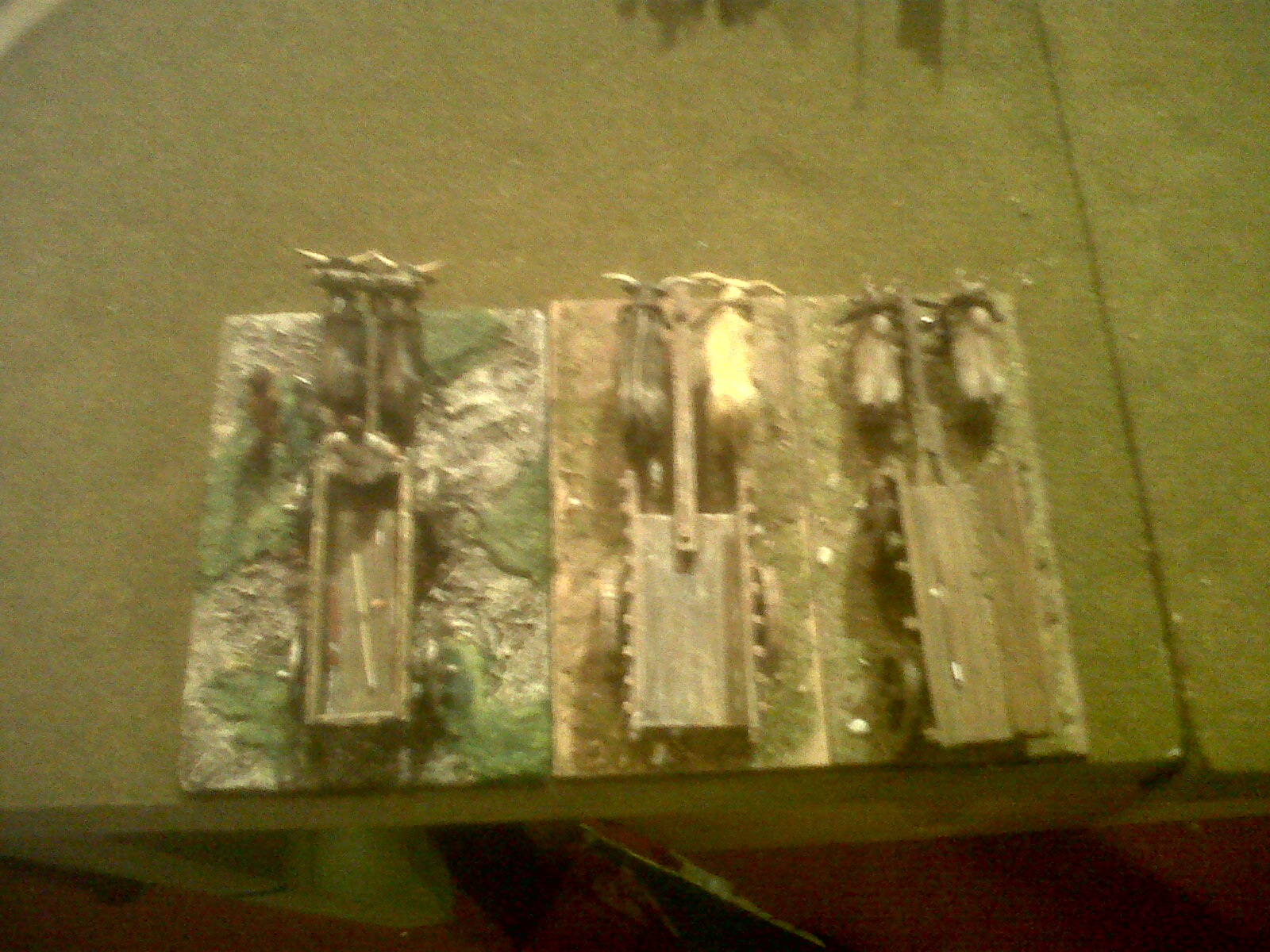
The Royalist Baggage, where Rupert keeps his bloomers, would Cromwell get his hands on them? The Royals seem to be keen on oxen? (See below):
Deployment "configured": Next let the action commence ...
Parliament is in crisis. Two Royalist armies are approaching London, either of which could defeat the "retrained" Parliamentarians. As a result the ground chosen to defend the approaches of London at Bedford was a curious mix of psychology and defensiveness (or should that read deafeatist mind-set). The Parliamentarians deployed in a corner triangle (see below):
The points of the triangle were a hamlet BUA (top right), a baggage camp behind a wood (bottom right) and a "Beetroot Field" (far left). A "flying column" of upgraded Parliamentarian cavalry forms the left wing of the army, infantry dominated elsewhere (see above).
The Royalists deployed a "wall of shot" with excellent cavalry on both wings, hiding a Macedonian Phalanx of Pike away from the attentions of the enemy (Parliamentarian) artillery. It would be interesting to see which way the artillery dual went (see above) as both sides deployed two large cannon. Parliament's center anxiously waited the opening rounds from the 'big guns' (see below).
The Parliamentarian right wing commander (me) wondered how to get his some of his mass of "shot" involved without opening the door to the Royalist mobile left wing (see below):
A close-up of the base of the Parliamentarian right hand triangle and the curious "flying column" something lCromwell must have been thinking about over the winter (and who said he didn't drink, I think too much eggnog is at work here). Dragoons, Shot, "vastly improved"Parliamentarian cavalry" and then Light Guns in the wrong place at the rear of the line (see below):
The "Beet Field", the namesake of the battle, full of Parliamentarian "shot" and soon to be the scene of one of the bloodiest slug-fests in our ECW campaign (see below):
To which the Royalist Right Wing (and he probably was to be fair) said "I'll 'ave 'em all" and promptly charged at the Parliamentarian Left (as they were politically leaning that way) in a aristocratic 'death or glory fashion' (see below):
Meanwhile the Royalist (far, far) Left could barely see the enemy and would spend most of the game marching to meet up with them, but were a useful "shot" and "cavalry" pack (see below):
A view from the Royalist Baggage Camp of the Royalist Artillery and "reduced" Pike Block, being kept in reserve as a sort of Triari formation, partly due to their vulnerability to artillery, partly due to the "no where to put them in this bad terrain" (see below):
The Royalist Baggage, where Rupert keeps his bloomers, would Cromwell get his hands on them? The Royals seem to be keen on oxen? (See below):
Deployment "configured": Next let the action commence ...
Labels:
1644,
25mm,
28mm ECW,
DBR,
ECW,
parliamentarian,
royalist,
Wargame,
wargame campaign
Subscribe to:
Posts (Atom)